Posted by: Thomas Richard | June 12, 2011

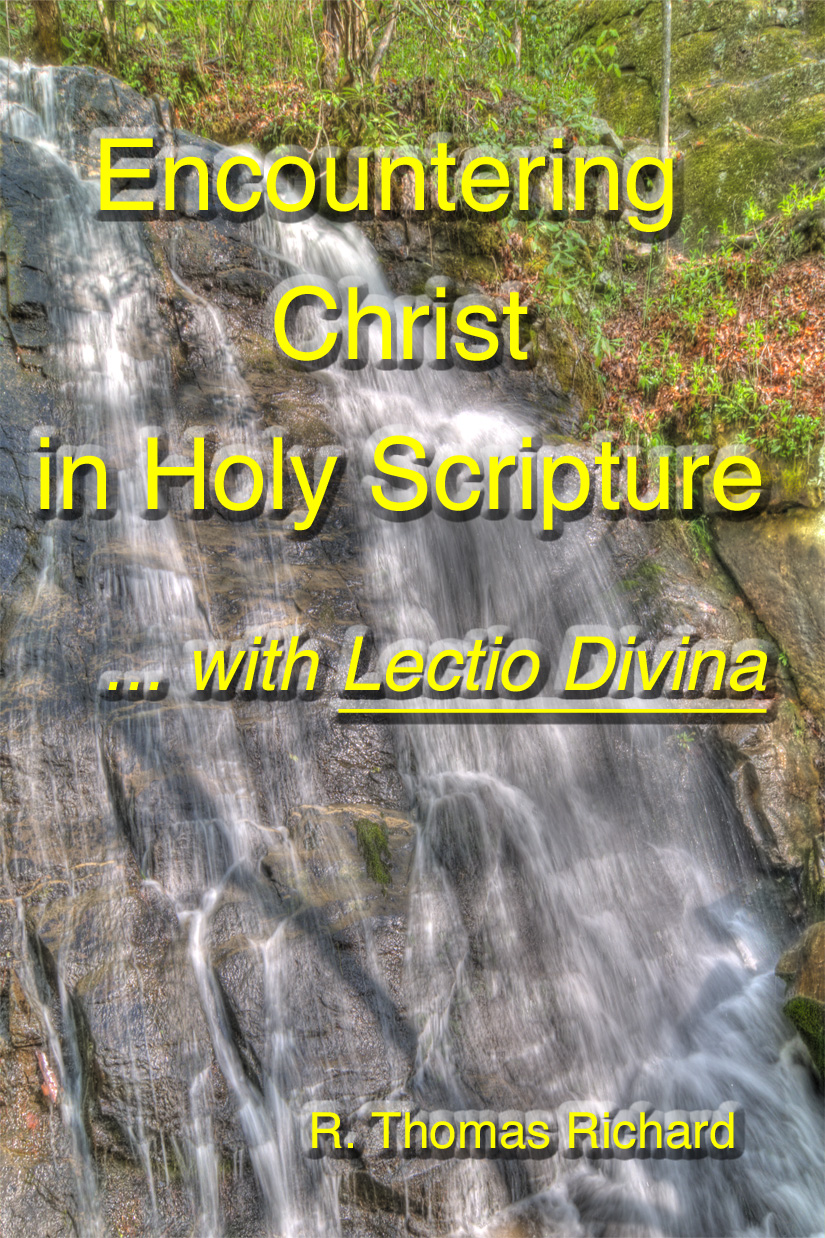
Encountering Christ in Holy Scripture with Lectio Divina

I’ve just put another e-book title into Amazon for the Kindle, and into Barns and Noble for the Nook. It is a small book, entitled Encountering Christ in Holy Scripture with Lectio Divina. I’ve thought for some time about doing something like this, because I believe there is a great need among Catholics for some better guidelines to help us all to learn to listen to Scripture, personally, in such a way as to hear that life-transforming word of Jesus. We Catholics need to better “become at home” in the saving word of God, so that He can better find a home within us. I finally sat down to write something in anticipation of a workshop I’m invited to give on the subject of Lectio Divina, at a diocesan conference on Hilton Head Island called, “Fire at the Beach” coming in September.

Lectio Divina, as you may know, is a method – a discipline – of listening to Scripture in such a way as to hear Christ, and hearing Him, to become transformed in Him. It is ancient, simple, powerful and effective in a heart that is open to Him. There are four traditional steps to the method, with a fifth step now often added as well. The four steps are these:
• Lectio – prayerful listening to some passage of Scripture,
• Meditatio – meditating upon the passage,
• Oratio – praying in response to the passage, and
• Contemplatio – a quiet resting in contemplation with Him.
• The fifth step – Actio – is enacting the truth of the passage in one’s own life.

In preparing for the workshop, I am discovering already several themes that seem to be crucially important for us in this time in our present cultural state and condition. These themes are crucially important, but scarce indeed in this culture of ours.

• (To practice Lectio) – the themes of proper reverence in the presence of The Holy in Scripture, and the stark beauty of solitude and of silence with His word. This in a culture that glorifies irreverence, group-think and noise.
• (To practice Meditatio) – the challenge of believing in objective and absolute revealed Truth, in the midst of this obsessively relativistic and skeptical age. And the challenge as well to submit to such Truth sincerely, personally, authentically.
• (To practice Oratio) – the theme of consecration – the radically faithful self-offering of personal consecration in one’s prayer to God. Even the reality, the existence of such a thing as consecration to God seems starkly out of place in this culture of independence, autonomy, emptiness and loneliness.
• (To practice Contemplatio) – the theme of communion in love with God in His word – a theme crucial to Christian life and indeed to our very humanity! – yet one that finds no place in the secular world so spiritually bankrupt in pragmatism and utilitarianism.

These themes – reverence, solitude, silence, Truth, consecration, communion, love – these are essentials! Human persons were made for these precious realities, yet look how impoverished our world has become: these realities are so rare. They are denied, discarded, suppressed, rarely even acknowledged as existing! They have become as meaningless dreams or ideals, so poor is our world today. Thus the crying need for discovery – or rediscovery – of them, to rightly judge this culture so empty of them.

Catholics have been given so much, and the world is in need of so much! If Catholics discover or rediscover, and embrace, what God has entrusted to us – then, perhaps, we can be the light that this darkening world needs. The darkness is growing, and so then is the need. May the Lord help us to become the help so needed, for to whom much is given, much will be required. There is much given, in the holy word of Scripture. Lectio Divina can help us find it.
Posted by: Thomas Richard | May 25, 2011

Truth, Goodness, Beauty

I’ve been talking with atheists and agnostics recently. It is so clear that faith is a gift! Unbelievers challenge me with the demand, “Prove that there is a God!” – Or that there is an afterlife, or absolute moral right and wrong, or that truth itself exists. They cannot even see, since they believe we accidentally evolved slithering out of slime and chaos, that “the beautiful” could be anything more than that which is pleasing for them to look at. Perhaps we can help them to look again, and more closely.

There is beauty, and goodness, and truth. And love exists. And when a person is able to see that there is more than futility, accident and death, he can begin to see past his own eyes to things that exist apart from him, that existed before him and that will endure beyond him. These transcendental realities invite us all to transcend ourselves. And if a person can hear the invitation of truth, and of beauty, and of goodness, perhaps he will pause for a moment and to catch a glimpse of what lies beyond the surfaces of things to things interior, at the foundations, within and under the dimensions of the material and the temporal. Perhaps first he looks toward God, and later to Him.

Some, even among atheists and agnostics, if they do possess a love for truth, will never stop looking until they see. We might be more helpful to atheists and agnostics if we stop pointing them to things that they cannot see, but instead to things that they can see. Maybe we should stop quoting Scripture to them that they are deaf to, and stop urging them to try to see what only eyes of faith can see, and instead point them to values God set into place for all men: transcendent values of truth, goodness, beauty, love – signs that point to Him. Then maybe later, they will see the more beyond the signs.

Beauty is a common word, but it has suffered shrinkage in our aesthetically challenged world. Some who live on the surfaces of life (even while feeling imprisoned in doing so) lead us to wonder to ourselves, “Do you not see the beauty there?” We wonder further, “How can you see the beauty there and just keep walking!” Some do see such beauty “there” (somewhere – anywhere) that it affects them, moves them, changes them irreversibly. Others, deadened within, say “Sure, oh yeah, of course. Very nice.” And they keep walking. But the man who does see – he stops walking for a bit because something is owed in return, when such a gift of seeing the beautiful is received.

There is something holy about the good, and the beautiful, and the true. Its holiness demands something of us. We owe something in return, not merely because the gift is pleasing to us and gives some passing momentary pleasure. No, the good and the beautiful and the true have a transparency to something greater than themselves, and they thereby invite us to something greater than ourselves.

Humanity is, today, in a place of deep confusion. Before his elevation to pope, Card. Ratzinger (homily in Mass before the Conclave, 2005) preached about the errors and dangers of relativism:

To have a clear faith, according to the creed of the Church, is often labeled as fundamentalism. While relativism, that is, allowing oneself to be carried about with every wind of “doctrine,” seems to be the only attitude that is fashionable. A dictatorship of relativism is being constituted that recognizes nothing as absolute and which only leaves the “I” and its whims as the ultimate measure.

Consider the distortion to these transcendental values of truth, goodness and beauty, in a culture under the sway of relativism:

Truth is not recognized as an attribute of God in Jesus Christ (“I am the way and the truth and the life”), nor even as an eternally existing and absolute reality independent of any human perception of it. Rather, “truth” is what “I” agree with and define to be true. What is true for me can be different from what is true for you, because there is no absolute truth.

Goodness is not recognized as grounded in the goodness of God (“No one is good, but God alone.”), nor even merely as a good common to all men for all times. There is no absolute good. Rather, goodness is what is good for me, what pleases me, what satisfies me. What is good for me might be very different from what is good for you, since we all have different tastes.

Beauty is not recognized as the eternal radiance of the eternally true and good (“I am the good Shepherd” is literally, “I am the Shepherd the beautiful.”). Rather, in the world of relativism, there is no beauty beyond what is aesthetically pleasing in some way to me. As for truth and goodness, for beauty it is the individual and his subjective preference that defines beauty and what is beautiful.

Thus in today’s world, the center of gravity of reality has shifted from the world in which I have been created and placed, to a world inside of me, to my perceptions and preferences and pleasures. To say that something is good, or true, or beautiful is to say something about me and what I think and judge, not about the thing outside of and independent of me. To see something beautiful is “really” to say, “When I look at that, I feel beauty in myself.” (See, for example, C.S. Lewis and The Abolition of Man.) Thus, the man of relativism is actually saying, “When I look at that thing I am beautiful.” It is all about me.

Of course, for all its self-centeredness and egoism, such relativism is not a bold assertion of actual self-importance and strength, but an admission of extreme poverty and loneliness. Such an aesthetic is bankrupt, and reveals even while being denied, an empty bravado and the terror of ultimate unimportance. The loudest ones among us have so little to say. The ones all self-centered are standing on nothing more substantial than their own poor and weak and transient thoughts – ideas – that can vanish in a moment. They possess nothing beyond the phantoms and fleeting phantasms of their minds, and are thus the most needy of all.

What are we to do? We need to become more prayerful, if we would be credible witnesses of an interior life more solid than the empty counterfeit that modernity offers. We need to walk and live ever aware of the eternal realities, and we need to stand on them, reverence them, indeed we need to return to them – to Him – their due. That is, truth and beauty and goodness deserve something of all of us because they point us by design to God. In Him we are to remain, and all that we are therefore ought to reflect His truth, beauty and goodness. All that we do ought to repay Him with human acts that are also good, true and beautiful. And if we, being then credible witnesses, point others to goodness and truth and beauty beyond what the unbeliever has thought and known under relativism, perhaps something will resonate in him. Perhaps he will stop walking and look again, listen again, and see anew. Perhaps he will be touched by and risk the invitation to transcendence, even by way of you or me. Faith is a gift – often received through the hands and loving patience of another.

Posted by: Thomas Richard | May 3, 2011

Auschwitz – a School of Holiness?

First, some examples easier to understand….

I know a couple who endured a really hard time with their son, who began his high-school years manifesting a serious problem with drugs. Their first reaction was understandable: in love, they reasoned and pleaded with him. They arranged counseling. They set curfews for him. They tried to monitor his activity. The problem grew worse. At great expense they sent him to residential rehab programs, which were effective as long as he was in residence. Their last resort was a program that included a requirement for them that was heart-wrenching: “tough love.” For their part they, his parents, had to agree to stop any form of cooperation with or enabling of this problem that was going to kill him if he did not stop it. They had to allow him to experience the real consequences of his self-destructive choices and behaviors. They had to let him experience the harm he was doing to himself. I’ll leave this story at this point – but it has had a good result and so far, the story, still continuing, is a happy one.

Alcoholics Anonymous found this same truth, years ago: very often the alcoholic (or drug abuser) must “hit bottom” before he can admit Step 1 of the AA Program:

1. We admitted we were powerless over alcohol—that our lives had become unmanageable.

This is a simple step, but one that is extremely difficult until that “rock bottom” has been hit. Mankind is stubborn and clever, and we can avoid for many years this basic, fundamental confrontation with a flaw in the core of our being.

There is a flaw at the very core of our being. We call it “Original Sin,” although the flaw actually is not “a sin” but rather the result of the original sin, the first sin of our first parents, Adam and Eve. From that sin, and that consequent flaw, follows every kind and sort of contradiction and sin that has infected and polluted and wounded every child of Adam and Eve since. There is a deep brokenness, a flaw in the human DNA, indeed now in all creation, that can be repaired only by the One who created us in the first place. To continue my reference to AA a step or two more, we see how beautifully they acknowledge this simple truth of the human situation. Steps 2 and 3 of the AA Program continue:

2. Came to believe that a Power greater than ourselves could restore us to sanity.
3. Made a decision to turn our will and our lives over to the care of God as we understood Him.

Yes, as AA says, “It works when you work it!” It “works” because it is the simple truth. The deep problems of man will not be fixed by mere education, or counseling, or talks or human concern. Deeper power and deeper healing is needed.

Second, the horror of the final end of man’s brokenness…

If a loving parent or friend can finally stop being an enabler of the self-destruction of a beloved other, by letting him see and experience and know that a fundamental and total change is needed, can we not understand something similar of our loving God? We are made for God, and only God can fill the void in our hearts and lives. Man cannot live in truth, in justice, in love apart from God. No matter how sophisticated the culture, or old the nation, or rich with human potential and accomplishment the civilization, any country is one generation away from a Nazi Germany, with its Auschwitz.

We must see through the veneers of human culture, the clean costumes and the pretty masks, and suffer to look into the pit of the darkness of sin with all its horror. God wants us to see, and to know clearly and completely and without doubt that we might turn – once and for all – to God who alone can restore us to sanity and wholeness. Jesus preached, “Repent, and believe the Good News!” First comes repentance, deep and true, then comes life-receiving faith in the innocent One who suffered for us on that Cross.

Years after the horrific evil of the Holocaust, in 1963 Karol Józef Wojtyła was made Bishop of Krakow, which made him also bishop of Auschwitz. What a cross this must have been, to add to the weight of his vocation to the Lord and His Church! Fr. Desolaters, the program director of the Centre for Dialogue and Prayer in Oswiecim, located near the concentration camp, said recently of this man who became pope, “Auschwitz was the school of holiness of John Paul II, which was immediately perceived by the people, because here Wojtyła understood totally what ‘faith’ means for the man of today.”

Auschwitz – a school of holiness. Can we put these words together, words that clash against and seem to contradict each other? If we can look at the Cross of Christ and see His love, then yes painfully we can. Where was God when the Nazis were exterminating His chosen people? God was there on the Cross, suffering with them and with us all in silence and with love, that we all might finally become heart-broken by the rock-bottom pits of sin. Look into the pit and repent, finally and forever, and believe the Good News. To all men suffering in the strife and agonies of sin, hear this: God is love. God loves you, God loves us all, and in Him there is life for you! Repent and believe the Good News. Yes there is the Cross, but yes there is the Resurrection.

Posted by: Thomas Richard | April 19, 2011

“But it shall not be so among you.” (Mt 20:26)

Archbishop Charles J. Chaput of the Archdiocese of Denver recently spoke with refreshing candor concerning the US Bishops as a whole, and their lack of simple candor on a matter of great moral importance: Catholic politicians who refuse to support Catholic moral teachings. The Church is shamed by so many Catholic Senators, Representatives, and now a Vice President – not exclusively but notably in the Democratic Party – whose public stances and voting records contradict clear Catholic teachings on many current moral issues. I’ve re-presented here parts of an article in the St. Louis Review (publication of the Archdiocese of St. Louis):

Archbishop Charles J. Chaput gave a frank response when asked why there is so much disunity among Catholics on the question of Catholics in political life standing clearly with the Church on major moral issues such as abortion.
“The reason … is that there is no unity among the bishops about it,” said the Denver archbishop, who was asked the question after his April 8 keynote address for the University of Notre Dame Right to Life Club’s spring lecture series.
“There is unity among the bishops about abortion always being wrong, and that you can’t be a Catholic and be in favor of abortion — the bishops all agree to that — but there’s just an inability among the bishops together to speak clearly on this matter and even to say that if you’re Catholic and you’re pro-choice, you can’t receive holy Communion,” Archbishop Chaput said.
The Archbishop said he and others have been trying to move the U.S. bishops’ conference to speak clearly on this issue for a number of years. However, there is a fear, he said, that if they do so, the bishops might somehow disenfranchise the Catholic community from political life, making it difficult to get elected if a Catholic politician has to hold the Church’s position on issues such as abortion and same-sex marriage.
The strategy clearly has failed, he continued, “So let’s try something different and see if it works. Let’s be very, very clear on these matters,” and he asked the audience to “help me to convince the bishops on that subject.”
“We act on what we really believe,” Archbishop Chaput said. “If we don’t act on our beliefs, then we don’t really believe them.”
The idea that the separation of church and state should force us to exclude our religious beliefs from guiding our political behavior makes no sense at all, he continued:
“If we don’t remain true in our public actions to what we claim to believe in our personal lives, then we only deceive ourselves, because God certainly isn’t fooled: He sees who and what we are. God sees that our duplicity is really a kind of cowardice, and our lack of courage does a lot more damage than simply wounding our own integrity; it also saps the courage of other good people who really do try to publicly witness what they believe. And that compounds the sin of dishonesty and the sin of injustice.”

I am left nearly speechless by this revealing of episcopal priorities. According to the Archbishop who certainly would know, many bishops believe it is better to keep quiet than to risk being truthful. Their moral mathematics concludes it’s better to look the other way than to risk “disenfranchising” our prominent “Catholic” politicians. Better to keep them in office, than to risk anything to keep them faithful.

Have these bishops forgotten that they are successors of the Apostles of the Lord? He sent them to “make disciples” – not to enable successful politicians. He sent them to preach and to teach the holy truth – not to pander and to help manipulate for votes. Please tell me that I’ve misunderstood! Please tell me I’m leaving something out!

I sincerely thank the Archbishop for his simple honesty, and admission of his own very difficult mission field among his fellow bishops. I sympathize with him, as he reaches out for support and help from us, the laity. It all does begin with us, the laity. Priests come out of the laity, in most instances from Catholic families, and bishops come from priests. It is possible for a man to truly have a vocation to serve, but to forfeit or lose that calling in his own preference of worldly things: worldly praise, pomp and circumstance – worldly ambition, worldly enjoyments. It is possible for a man to be called to the Cross – to the Gospel at any cost – but to turn from it for the love of power and self-glory.

St. Augustine saw it, many years ago, and he described very well the two cities, the two kingdoms, the two generations of men that have inhabited the earth since Cain and Abel. In his book The City of God, Augustine saw these two cities: the city of man, and the city of God. In the city of man, rulers rule for the love of ruling. In the city of God, rulers rule for the love of serving. The difference is radical and stark.

Pope John Paul II saw it much more recently, and he described very well the two cultures now at battle among us: the culture of life, and the culture of death. There are citizens of the city of God in the world, living a culture of life, working and bearing witness among men who dwell in the city of man. And this is as it should be: this is our vocation, to be Christ’s light in this dark world! But there are also citizens of the city of man, perpetuating a culture of death, working in the Church – working in the city of God among those of the city of God!

Sometimes the lines are blurred. Sometimes we cannot tell, on a given issue, what is the true good that must be defended, and what is the evil that is embedded and hidden within by the enemy, the father of lies and deception. Thus we need our bishops to be trustworthy teachers of the one Truth we must live by! Thus Jesus sent them, to be trustworthy witnesses of His Gospel and His life.

On the other hand, on some issues there is no ambiguity and no room for doubt. There are truths that ought to be embedded in the bones and clear in the consciences of every Catholic Christian, including our bishops. Life begins at conception, and life is sacred: You shall not take the life of an innocent person, not ever. Human sexuality is sacred, a holy human participation in the life of God, both signifying and enabling union in love, and the procreation of the human race. The truth of God is not negotiable, or expendable, or political currency to be exchanged in the marketplaces or voting booths of the city of man. The truth of God is worth living for, and even dying for.

Catholics, we need to support our faithful bishops, and we ought to encourage our wavering and uncertain bishops. Perhaps there are some bishops we cannot speak to, because they will not listen. But for all our bishops we must pray, because God is still in control of this Church – His Church, His holy Church. And we, as opportunity allows, must speak the truth because the truth must be spoken. May the Lord give us the graces and light and courage we need, in these troubling times, to remain faithful.

Thomas

Posted by: Thomas Richard | April 4, 2011

Art as Parable

Maybe art is always parable. All that has being was made by the only, the one, God: His truth is at the foundation of all things. Certainly all great art – whether music, writings, paintings, photography, dance – all great art, I would say, somehow in one way or another expresses some fragment of the one Truth that God expresses in His creation. For this reason, I would say, men turn to art as they seek truth because men seek God.

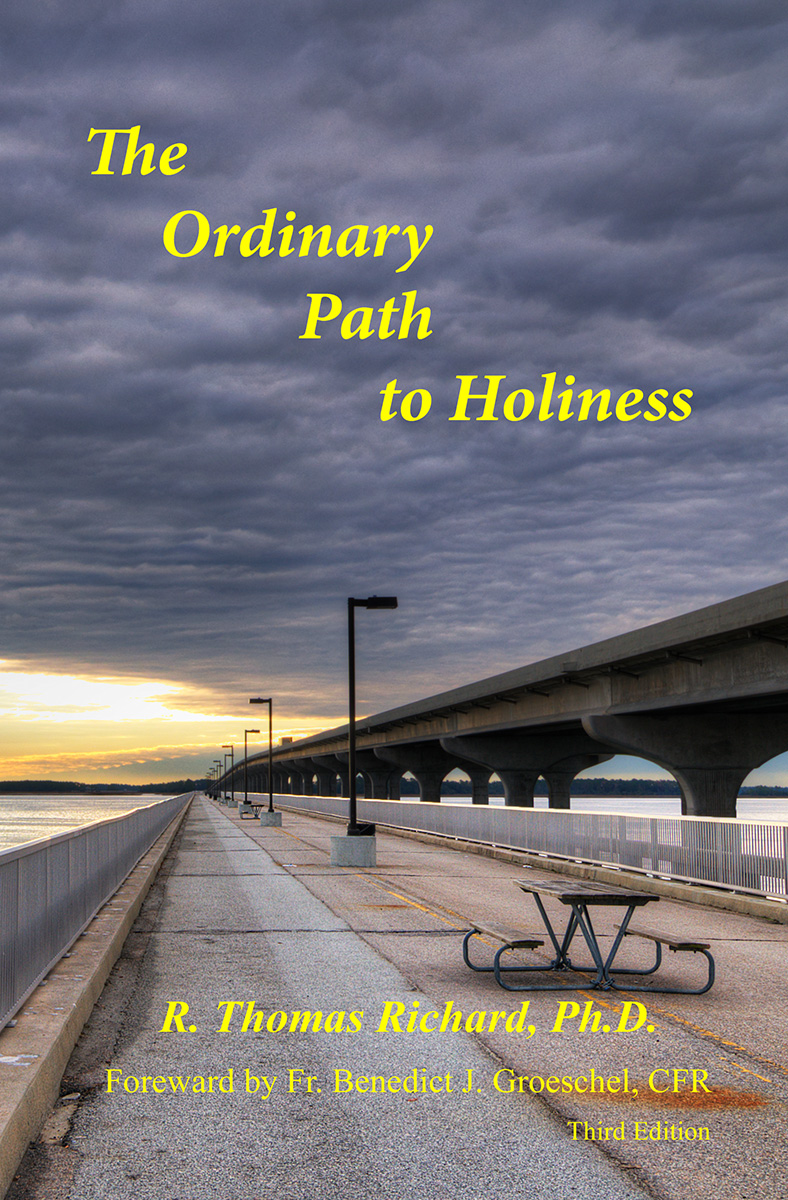
Well this is all to introduce this blog post: the parables found in creation and photographed, and used as cover art for my books. I want to try to express in words what may be obvious in the photography – but maybe it isn’t. Both books are now out and available in digital form for the Kindle and the Nook e-readers with these new “covers”.

The Ordinary Path to Holiness

(The photograph is of the old Broad River Bridge, now only partially standing, and used as a fishing pier.)

The way is straight – if we will only keep to the way! There are resting places along the journey, because God is patient and merciful. There are lights along the way, because God is patient and merciful. But we must keep our eyes – the eyes of faith, in this case – we must keep our eyes fixed on the end, the final purpose and intent of it all: The Light, the Glory, the Alpha and the Omega, God.

Pope Benedict recently reminded us that we are all called to become “fishers of men.” For fish, to remain in the waters is life, and to be caught by the fishermen is death. But for us, the opposite is true. For us, to remain in the waters is death, but to be caught by the fishermen and pulled up into the air is life. Now we have been called as fishers of men, and our task is one of life and death.

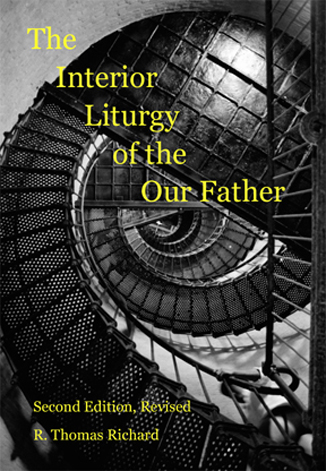
The Interior Liturgy of the Our Father
The Journey of Ascent, in Stations

(The photograph is of the inside spiral staircase of the old Hunting Island Lighthouse.)

Our journey is one of ascent, and the climb is not an easy one (especially as we get older!) The Lord cautions us, “How narrow the gate and constricted the road that leads to life. And those who find it are few.” (Mt 7:14) Yet He also encourages us, saying, “Take my yoke upon you and learn from me, for I am meek and humble of heart; and you will find rest for your selves. For my yoke is easy, and my burden light.” (Mt 11:29-30)

Is the way difficult, or is it easy? Yes. Yes. And His way is the only way for us, lest we fall into chaos, insanity and despair. God made us for Himself – for holy communion in Him – and all else contradicts our very being. So let us climb! Let us pursue the one goal worthy of a human person: true fellowship, blessed and holy communion in God.

Blessings and peace.

Thomas

Posted by: Thomas Richard | March 24, 2011

Digital Spirituality

For the past weeks I’ve been getting to know my computer like never before. Many, many hours I’ve been sitting here at work, first to revise the web site (www.renewthechurch.com), and more recently to reformat my books on spirituality and prayer for the new e-readers, the Amazon Kindle and the Barnes and Noble Nook. Why? Glad you asked.

The world is in a dangerous position, more so than I’ve ever seen. And I remember the drills in elementary school, hiding under our desks, in preparation for possible nuclear attack! But this is different – a different and deeper danger, reaching down into the soul of America where we are now most vulnerable. America hardly knows who she is anymore. A profound moral confusion has crept in among us, and into many, many of us. Right and wrong have intermixed and blended. Reality and fantasy, truth and lies – the polar opposites that used to be fundamental to defining the character of men and women, have found a deadly compromise. We have become as a nation weak and shallow, and dangerously vulnerable to what is most dangerous and lethal: the lie.

So for some years I thought that our greatest need was truth – the Gospel truth of sin and salvation, forgiveness, righteousness and holiness. But I come to believe now that it is not doctrinal accuracy that we need the most, nor the teaching of Christian morality, nor the meaning of the sacraments. Yes, Catholics are poorly catechized on these important matters, and they are important! But I have come to believe that prior to substantive knowledge, prior to right education, something else must be in place or it is all building on sand. We need to meet Christ; we need to encounter Him, and be encountered by Him. We need to come face to face, so to speak, with the supernatural and eternal that alone unmasks the falsity and hypocrisy and duplicity now so common and unremarkable. We need to find God and be transformed, lest we will never break the hold the world has on us.

So, back to my wrestling with website design, html code, .gif and .mobi and .prc and formats that e-book readers can work with. Maybe if I can get my two humble little books on prayer and Catholic spirituality out there, persons can be helped to pray and to grow in prayer – and there, in the silence and solitude of prayer, maybe persons can seek the One who seeks to be found. Until we meet Him, doctrine remains on the surface, morality remains law, sacramental grace remains much squandered and mostly lost.

We need to discover prayer, the holy communion of prayer. We need to touch Him and be healed. We need to be converted, and renewed, and consecrated and sent. The world needs a holy Church, as darkness needs light. And the darkness seems to be growing.

Thomas

Posted by: Thomas Richard | March 5, 2011

When the Son of Man comes…

“When the Son of Man comes, will He find faith upon the earth?” (Lk 18:8)

Jesus gave us some troubling warnings, as His own Cross approached.  There would be dark times – times of an ascendancy of evil and lawlessness – before He would come again.  The world would not get better and better and then He would come and celebrate with us for the great success story of the Church!  The Church was sent to be light to the world, and to make disciples of all nations – but we were warned that the world would not embrace the Gospel and be converted easily.  No, only through great tribulation, rejection, persecution, trial and suffering would righteousness finally prevail.

The Catechism of the Catholic Church echoes this:

Catechism 675 Before Christ’s second coming the Church must pass through a final trial that will shake the faith of many believers.<Cf. Lk 18:8; Mt 24:12>

Read More…

Posted by: Thomas Richard | February 19, 2011

The Enmity Among Us

Eph 2:14 For he is our peace, he who made both one and broke down the dividing wall of enmity, through his flesh,

15  abolishing the law with its commandments and legal claims, that he might create in himself one new person in place of the two, thus establishing peace,

16  and might reconcile both with God, in one body, through the Cross, putting that enmity to death by it.

Paul is speaking here of that enmity dividing the Jew from the Gentile – the division broken and the enmity healed by His holy Cross.  This supernatural, powerful reorientation in the hearts of believers comes to my mind these days as we witness clash after clash of adversaries.  Human experience defines itself in terms of adversaries.  The human drama reduces itself to a binary struggle between two human groups.

Reformers in Egypt in the streets and the squares, protest the dictatorship of the now-former president; protestors now in many nations in the Middle East, demand democratic freedom or perhaps sharia law; protestors in the streets of Greece and of England loot and break windows to oppose government budget cuts.  Even in the popular adversarial games we in America choose for entertainment, one side battles the other side, my side battles their side, at the Superbowl or the World Series or whatever pinnacle the sport in question labels as the ultimate confrontation.  In politics, class warfare becomes the language of the game and we play it; the culture war gives us another arena, and again men are from Mars and women, Venus.  Here and there and everywhere, men divide themselves into two sides and thus the real war is reduced, simplified, transferred and avoided.

There is an enemy of souls – an enemy of human souls, and he is not human but is a spirit: the evil spirit, satan.  Jesus reveals this to us on the Cross, showing us that our common enemy has made casualties of us all indiscriminately.  The evil hand penetrated the human soul and he left a wound that makes us enemies of one another, and thus he has made us enemies of our very selves.  We find no peace with anyone, because we are not at peace within ourselves.  A war rages and it is not external only, but it begins within and it ends nowhere and not ever except at the Cross.  Only at the Cross will we find peace, interior and exterior.  Only at the Cross will we find social justice, and human rights, and freedom and victory.  Only at the Cross by way of deep, radical, transforming repentance and conversion will we find healing and peace.

If the problem was solved 2000 years ago, why does it persist?  We in the Church ought to ask ourselves that question, maybe as part of a regular Examination of Conscience before Confession.  Vatican II reminded us that we are all called to holiness and to the perfection of charity: how the transforming light of Christ would radiate in and illuminate this dark world, if we would hear that call to holiness and take it seriously!  Holiness and holy love – divine love, agape love, charity – ought to define the Church!  Instead so many of us limp from Sunday to Sunday in mediocrity, hardly distinguishable from the lost and the confused around us.  Have we ever stood under His Cross, and had His precious blood drip into our cold hearts to enkindle and enflame them?  Has His sweat fallen upon our lukewarm works to ennoble them?  Where is the fire of Truth that Christ entrusted to His Church – why does it remain so safely buried, while the world remains untouched, unchanged and crying in need?

Thomas

Posted by: Thomas Richard | February 1, 2011

Prayer and the Four Pillars of the Faith

The Church speaks of the “four pillars of the Faith” for good reason.  The four together make for a strong and stable Faith – one that can persevere, endure and grow.  Something is lacking, if one or more of the four is lacking!  The four together reinforce one another, and the house is secure.

The four are most simply named Creed, Sacraments, Morals and Prayer.  The Catechism is organized with these four as major sections:

  • Part One: The Profession of Faith
  • Part Two: The Sacraments of Faith
  • Part Three: The Life of Faith .
  • Part Four: Prayer in the Life of Faith

We can see a certain logical order in this sequence: first is what we believe – the content of our Faith.  This is the Truth that we believe. Next the Sacraments include the means by which this Truth is made present to us: the means of grace that brings communion with God who is Truth.  Third, the moral life, includes the way in which this Truth is lived in human lives, by human persons.

The fourth pillar, prayer, which seems the simplest and most obvious, is perhaps the least understood of all.  Many Catholics think “prayers” when they think “prayer.”  They think of this prayer or that prayer – perhaps memorized prayers that are trusted and often repeated by Catholics in general, or perhaps personal and spontaneous prayers that are uttered privately, maybe in silence, with great hope that the Lord will hear and answer.  But “prayer” in our Catholic Faith is much more – it is a treasure largely undiscovered; a gift therefore greatly unappreciated and undeveloped.

Here is one Catechism paragraph on the beautiful mystery of prayer:

2564 Christian prayer is a covenant relationship between God and man in Christ. It is the action of God and of man, springing forth from both the Holy Spirit and ourselves, wholly directed to the Father, in union with the human will of the Son of God made man.

Prayer is that relationship with God in Christ, the truth of which is understood by the Creed. Prayer is that relationship with God, which is enabled and nurtured by the grace and presence of Christ in the sacraments. Prayer is that relationship with God, which is lived out according to the moral life given us in Christ. Yes, prayer is that relationship with God in Christ; prayer is that blessed intimate covenant communion that is illuminated, enabled and lived in the other three pillars. How is it that our life of prayer is so typically neglected when it is so crucially important to us?

If our life of prayer is our covenant communion with God in Christ, why is it not our first concern, instead of, typically, our last?  We can see how it could be listed last in a logical sequence, because it is not even understood except by the support of the other three.  But ought it be the last listed in our concerns, our attention or our pursuits?  To ask it even more pointedly: if our personal relationship with Christ is dusty, stagnant and cold, then what good is accurate knowledge about Him, and meeting Him frequently in the sacraments, and even refraining from acting in ways that would dishonor Him?  Remember the hard words of Jesus to some on Judgment Day, “I never knew you.”

Prayer is our covenant communion with God in Christ.  In prayer we come to know Him and He us, Person to person.  In prayer we walk with Him and He with us.  In prayer we remain in Him, and He in us.  In prayer we live our vocation from the beginning; in prayer we journey toward our eternal destiny with God the Holy Trinity.

Brothers and sisters, let us not neglect our life of prayer.   Each of the four pillars of the Faith directs us to God in Jesus Christ.  All four pillars together, like the four pillars supporting an altar, lift up our worship making it worship in spirit and truth – worship that the Father seeks and desires.

Thomas

Posted by: Thomas Richard | January 29, 2011

The Holy Vocation of Catechist

What is the difference between a lukewarm Catholic Christian and the average pagan?  The lukewarm Catholic, sadly, is hardly distinguishable from the average pagan – on the street, in the voting booth, in court, behind closed bedroom doors, or in the workplace.  There is a difference: the lukewarm Catholic Christian – whether culpably or innocently – was entrusted with holy and divine grace that he squandered and wasted and perhaps even lost, as soon as it was given him.

We hardly know what we have!  Such radiant treasures have been placed in our care – seven sacraments like seven facets of a perfect diamond, flashing brilliantly in the full sun; we cannot look directly into it, into Him!  Seven sources of holy grace, each offering us communion with Him, each an intimate embrace, each touching Him, each the loving touch of God in return.

We do not know what we have.  We are like so many of the crowds, pressing upon Jesus, yet never touching Him:

Lk 8:42 … As he went, the crowds almost crushed him.
43  And a woman afflicted with hemorrhages for twelve years, who (had spent her whole livelihood on doctors and) was unable to be cured by anyone,
44  came up behind him and touched the tassel on his cloak. Immediately her bleeding stopped.
45  Jesus then asked, “Who touched me?” While all were denying it, Peter said, “Master, the crowds are pushing and pressing in upon you.”
46  But Jesus said, “Someone has touched me; for I know that power has gone out from me.”


We need true catechists, passing on the living and dynamic Faith of the Churchmaking, as Jesus commanded, disciples.  A true catechist is responding to a holy vocation.  Do we pray for vocations to the priesthood and religious life?  Yes, we do and rightly so.  But are we praying for catechists?  And are we praying for true responders to the sacred vocation of marriage: husbands and wives, fathers and mothers, catechists who are making disciples in the Domestic Church of the Catholic home? From the General Catechetical Directory #80:

“The definitive aim of catechesis is to put people not only in touch, but also in communion and intimacy, with Jesus Christ”. (CT 5) All evangelizing activity is understood as promoting communion with Jesus Christ.


All the “problems” of the Church today have one solution, ultimately.  The simplest of solutions: Jesus.  We need to meet Him, to hear Him, to touch and be touched by Jesus Christ.  We don’t need to “study” the Bible – we need to hear His Word. We don’t need to “get” the sacraments – we need to receive deep in the deepest places of our souls, His holy grace given us in the sacraments.  We don’t need to learn more prayers, we need to pray and to meet Him in holy prayer-communion; we need to live a life of prayer.  We don’t have attendance or budget problems – our crisis is the wrong kind of poverty of spirit.

He is so close to every one of us!  But He was close to the crowds too, as they pressed upon Him.  One touched Him.  One touched Him.  One touched Him.

Thomas

« Newer Posts - Older Posts »

Categories