Posted by: Thomas Richard | September 19, 2012

Faith in the “Year of Faith”

When I read the Catechism description of the theological virtue of Faith, I am forced to conclude that we Catholics are not doing justice to the gift of faith given to us.  The Catechism has this, first of all:

Catechism 1814 – Faith is the theological virtue by which we believe in God and believe all that he has said and revealed to us, and that Holy Church proposes for our belief, because he is truth itself.

OK – most Catholics would probably assent easily and quickly to that definition.  Catholics do believe in God, and we readily recognize the authority of the Church to preach and to teach in His name.  The Catechism continues, however, to include this also:

Catechism 1816 – The disciple of Christ must not only keep the faith and live on it, but also profess it, confidently bear witness to it, and spread it: “All however must be prepared to confess Christ before men and to follow him along the way of the Cross, amidst the persecutions which the Church never lacks.”<LG 42; cf. DH 14> Service of and witness to the faith are necessary for salvation: “So every one who acknowledges me before men, I also will acknowledge before my Father who is in heaven; but whoever denies me before men, I also will deny before my Father who is in heaven.”<Mt 10:32-33>

Hearing this, many Catholics whom I know would pause and look down to the floor.  I’ve heard too many Catholics, who have a beautiful and quiet relationship of faith with God, have to admit about their Catholic faith and their Catholic Church, “But I can’t explain it to anyone!”  They feel very awkward in trying to “confess Christ before men,” or giving “witness of the faith” that is “necessary for salvation.”  They would never want intentionally to “deny” Him before men!  But they are ill-prepared to “acknowledge” Him explicitly, clearly, intelligibly.

Yes, all these Catholics have received the Sacrament of Confirmation – with the grace needed to make one a witness of Christ before men!  Yes they receive Eucharist weekly, if not more frequently.  Yes they know the common and traditional prayers of the Church.  But they do not know the Catechism – they do not “know” in the sense of being able to state and explain it – our faith.  They are not at ease with the Bible, nor able to locate particular books quickly, nor able to quote or easily find important passages for the sake of witnessing to others.  They are not able to defend the Catholic faith when questioned or attacked by relatives or neighbors or “friends.”

The disciple of Christ must not only keep the faith and live on it, but also profess it, confidently bear witness to it, and spread it: “All however must be prepared to confess Christ before men and to follow him along the way of the Cross,…

These are strong words, and they expose a grave weakness in us: we are not able to do what we “must” do.  The faith among us in the Church is weak, and the challenges and attacks aimed at and assaulting us are growing in ferocity and strength.  What are we, the Church, doing about it?

In a recent address to the bishops of Colombia, the Pope listed several points of concern for bishops in this age of religious pluralism that is luring Catholics away from the Church:

  • Hence, it is about being better believers, more pious, affable and welcoming in our parishes and communities, so that no one will feel distant or excluded.
  • Catechesis must be promoted, giving special attention to young people and adults;
  • homilies must be carefully prepared, as well as
  • promoting the teaching of Catholic doctrine in schools and universities.
  • And all this to recover in the baptized a sense of belonging to the Church and to awaken in them the aspiration to share with others the joy of following Christ and of being members of his Mystical Body.
  • It is also important to appeal to the ecclesial tradition, to promote Marian spirituality and to take care of the rich devotional diversity.

Since he listed several of keen interest to me, I repeat them:  We need adult catechesis and formation in the faith!  We need more substantial and more fervent homilies!  We need to awaken the baptized!  We need to promote, enable, guide, strengthen, ignite the interior life of prayer in the faithful, as Mary our mother in Christ shows us!

The parable of the ten virgins seems especially relevant, at this time in church history:

Mt 25:1 “Then the kingdom of heaven shall be compared to ten maidens who took their lamps and went to meet the bridegroom.
Mt 25:2 Five of them were foolish, and five were wise.
Mt 25:3 For when the foolish took their lamps, they took no oil with them;
Mt 25:4 but the wise took flasks of oil with their lamps.
Mt 25:5 As the bridegroom was delayed, they all slumbered and slept.
Mt 25:6 But at midnight there was a cry, ‘Behold, the bridegroom! Come out to meet him.’
Mt 25:7 Then all those maidens rose and trimmed their lamps.
Mt 25:8 And the foolish said to the wise, ‘Give us some of your oil, for our lamps are going out.’
Mt 25:9 But the wise replied, ‘Perhaps there will not be enough for us and for you; go rather to the dealers and buy for yourselves.’
Mt 25:10 And while they went to buy, the bridegroom came, and those who were ready went in with him to the marriage feast; and the door was shut.
Mt 25:11 Afterward the other maidens came also, saying, ‘Lord, lord, open to us.’
Mt 25:12 But he replied, ‘Truly, I say to you, I do not know you.’
Mt 25:13 Watch therefore, for you know neither the day nor the hour.”

The darker the night grows – and the darkness is growing! – the more needed is the precious oil to give light.  Some have sufficiency for the night, but some do not.  In the mystery of this oil – this unction – this that burns with the light of Truth – we cannot give to another what they must gain for themselves.  Now is the time for Catholics to fill their hearts and souls with His precious oil!  May He help us awaken, while there is still time.

Thomas
Posted by: Thomas Richard | September 4, 2012

New Blog – “Court of the Gentiles”

Pope Benedict, a while back, called the Church to make a “space” for unbelievers, for questioners, for seekers, following the Old Testament literal space in the Temple area, the Outer Court, called “the Court of the Gentiles.”  He calls us to a dialogue with the world, with “the Gentiles” so to speak, so that through such genuine and sincere encounter we might be witnesses to the saving Truth that all men must seek.  He wrote:

Dear young people, it is up to you, in your own countries and in Europe as a whole, to help believers and non-believers to rediscover the path of dialogue. Religions have nothing to fear from a just secularity, one that is open and allows individuals to live in accordance with what they believe in their own consciences. If we are to build a world of liberty, equality and fraternity, then believers and non-believers must feel free to be just that, equal in their right to live as individuals and in community in accord with their convictions; and fraternal in their relations with one another. One of the reasons for this Court of the Gentiles is to encourage such feelings of fraternity, over and above our individual convictions yet not denying our differences. And on an even deeper level, to recognize that God alone, in Christ, grants us inner freedom and the possibility of truly encountering one another as brothers and sisters.

Deborah and I are creating a new blog, to be in addition to this one, to be devoted to such an outreach to non-Catholics and to non-believers who are truly open to dialogue and mutual respect.  I invite Catholics to be part of the dialogue also!  I invite you all to visit there, to comment for the purpose of true dialogue.  We want to try to give account of the faith we have been given, and to listen to the questions, the beliefs, the thoughts of non-Catholics as well.

The new blog is called “Court of the Gentiles: Seeking the Absolute.”  Please visit the blog, and if you would like to be part of the discussions then know you are welcome and invited!  I hope we can have many contributors, both Catholics and non-Catholics and non-believers.

Thomas

Posted by: Thomas Richard | August 31, 2012

Thoughts after the Republican Convention

In this age of creeping (or surging) practical atheism, a very beautiful witness to “true religion” was broadcast in the country last night – by a Mormon. One of the interesting twists in this presidential race is that a Catholic will definitely be elected Vice-President, no matter who wins. We can’t see into hearts, of course, but Mr. Ryan seems to take his Catholic faith seriously, praise God, whereas I grieve to say that Mr. Biden seems to consider it an option. I haven’t heard from him, or from the Democratic Party, a recognition of the inviolable right to life or the sanctity of marriage. To me, the right to life is crucial – essential. Without the right to life, all further discussion of any other rights is hypothetical. A dead child has no rights anymore, not in this world.

So a Catholic will be our Vice President. The question is, will he be to the shame of the Church or to her honor? Will he add to the illusion of “disposable religion” for public officials or will he counter this corruption with a contrary example of honoring the Catholic Faith? Practical atheism is a deadly lie, an insidious infection in the heart of the West now spreading throughout the American culture, a lethal moral virus that kills from within the very humanity of its victims. The Church continues mostly to sleep, but thank God some of her members are awake and alive and not ashamed to be different from the world around them.

The second interesting twist in this campaign is the head of the Republican ticket: a Mormon, Mitt Romney, who is not ashamed to take very seriously the biblical moral demands of his faith. The Bible teaches:

James 1:22  But be doers of the word, and not hearers only, deceiving yourselves.
James 1:23  For if any one is a hearer of the word and not a doer, he is like a man who observes his natural face in a mirror;
James 1:24  for he observes himself and goes away and at once forgets what he was like.
James 1:25  But he who looks into the perfect law, the law of liberty, and perseveres, being no hearer that forgets but a doer that acts, he shall be blessed in his doing.
James 1:26  If any one thinks he is religious, and does not bridle his tongue but deceives his heart, this man’s religion is vain.
James 1:27  Religion that is pure and undefiled before God and the Father is this: to visit orphans and widows in their affliction, and to keep oneself unstained from the world.

Friends and co-workers of Mr. Romney testified at the Convention of his quiet and selfless heart-felt obedience to this religion that is “pure and undefiled before God.” What a refreshing and different political experience was that Republican Convention: their focus on goodness, the goodness of life, the goodness of freedom, the goodness of the human spirit, the goodness of courage, commitment, sacrifice and work, the goodness of honor, of family, of marriage, of children, of life! This country needs to be stirred again by goodness, to goodness! The deadening spirit of godlessness, of moral relativism, of emasculated entitlement and dependency – let these lies be cast aside as unworthy of human persons and cultures.

It is claimed that the Romney-Ryan ticket means there is no Protestant on the presidential ballot of a major party for first time. To me, the significant fact is that both of these candidates on the Republican ticket – both for president and for vice-president – are men who know, who hold, and who live by that Natural Moral Law set by God in the heart of every man. They live a practical theism – not the practical atheism that is killing Western culture, whatever religious label men might appropriate to themselves. They live a religion that honors God and every man, especially the very least among us.

How our country needs men and women of righteousness as our leaders.

Posted by: Thomas Richard | August 13, 2012

A Contemplative Spirit

“She kept all these things in her heart.” the Virgin Mary demonstrates a humble openness to matters of God – matters she did not understand at first. Mary does not insist on everything from God being immediately simple, plain and clear. Mary teaches us something about patience in the midst of holy mysteries.

Lk 2:48 And when they saw him they were astonished; and his mother said to him, “Son, why have you treated us so? Behold, your father and I have been looking for you anxiously.”
Lk 2:49 And he said to them, “How is it that you sought me? Did you not know that I must be in my Father’s house?”
Lk 2:50 And they did not understand the saying which he spoke to them.
Lk 2:51 And he went down with them and came to Nazareth, and was obedient to them; and his mother kept all these things in her heart.

Mary, the Mother of our Lord, demonstrates a related quality that comes easily to some, but may require intention and commitment of others: a contemplative spirit. Some have this gift and live it easily – as did another Mary, the sister of Martha. Martha heard Jesus point to her sister Mary as an example for her, that she also might develop this virtue, a virtue the Lord called the one thing needful.

Lk 10:38 Now as they went on their way, he entered a village; and a woman named Martha received him into her house.
Lk 10:39 And she had a sister called Mary, who sat at the Lord’s feet and listened to his teaching.
Lk 10:40 But Martha was distracted with much serving; and she went to him and said, “Lord, do you not care that my sister has left me to serve alone? Tell her then to help me.”
Lk 10:41 But the Lord answered her, “Martha, Martha, you are anxious and troubled about many things;
Lk 10:42 one thing is needful. Mary has chosen the good portion, which shall not be taken away from her.”

Two Marys, one example of the human essential. Commenting on Mary the Mother of our Lord, Card. Ratzinger said the following in the book, Mary – The Church at the Source (Ignatius Press 2005, p. 71):

… with the scene centering on the twelve-year-old Jesus in the Temple. The first stage is “they did not understand the saying which he spoke to them” (Lk 2:50). Even for the believing man who is entirely open to God, the words of God are not comprehensible and evident right away. Those who demand that the Christian message be as immediately understandable as any banal statement hinder God. Where there is no humility to accept the mystery, no patience to receive interiorly what one has not yet understood, to carry it to term, and to let it open at its own pace, the seed of the word has fallen on rocky ground; it has found no soil.
Even the Mother does not understand the Son at this moment, but once again she “kept all these things in her heart” (Lk 2:51).

Every human person must listen to this, and hear it. A contemplative spirit, a listening and remembering heart, a focus on the holy truth of God – this is essential to us all. There must be humility. There must be patience. There must be a heart of good ground, allowing the mystery of God’s truth to be carried to term and come forth in holy wisdom. We see here in the Blessed Mother Mary an essential characteristic of a disciple of her Son. We see it in the example of Mary the sister of Martha. And we see in Martha, a woman caught in a busyness that distracted her from the one thing necessary, something to be overcome in us all.  As Jesus said, it is a choice to be chosen.  We cannot allow ourselves to hide behind busyness, or be distracted by the noise and the empty activity of this world.

We must develop in ourselves an attitude of prayer. We must learn to listen to Him, so as to hear – really hear – God who speaks to us. We must look so as to find Him, here and now, present every moment. What a tragedy it would be to realize too late that the very One we have been seeking was all the while right beside us, waiting for us to know Him.

What Pope Benedict XVI said bears repeating:

“Even for the believing man who is entirely open to God, the words of God are not comprehensible and evident right away. Those who demand that the Christian message be as immediately understandable as any banal statement hinder God. Where there is no humility to accept the mystery, no patience to receive interiorly what one has not yet understood, to carry it to term, and to let it open at its own pace, the seed of the word has fallen on rocky ground; it has found no soil.”

(See also The One Thing Necessary blog post.)

Freedom and Law, Life and Disease, Contraception and Abortion

Our government, arguing for the current HHS “Obamacare” mandate that includes contraceptive coverage, sees no guarantee of  freedom of religion for “secular entities”, allowing such freedom only to churches.  HERE is a summary.  The Justice Department stated to the judge that “for-profit, secular employers generally do not engage in any exercise of religion protected by the First Amendment.”  “A secular entity by definition does not practice religion,” the Obama administration argued.

This is astounding to me.  I am a “secular entity.”  Hence I have no freedom of religion?  It seems that (for now) a church has some freedom to gather on Sundays and pray and talk about religion – but the people in the pews have the freedom to live only such religion that the government permits.  This administration believes that it knows, better than our God, what my social obligations are.  Federal law supersedes moral law, and God.

Defending the HHS mandate, administration attorneys added:

Lack of contraceptive use has proven in many cases to have negative health consequences for both women and a developing fetus … Accordingly, through the requirement that health coverage includes coverage for contraceptive services without cost-sharing, defendants seek to further an indisputably compelling interest in the promotion of women’s health and the health of potential newborn children.

Let’s get this straight: “lack of contraception has negative health consequences for both women…” – that is, pregnancy for the woman is equivalent to disease, or illness – “and a developing fetus” – that is, the child in the womb would be better off never having been conceived.  A child in the womb, created by God in the divine image, possesses a life that is for him or her a terminal disease calling for the cure of death.  The Orwellian “new-speak” that we have come to, is breathtaking.

Their argument for the good of contraception continued:

Contraceptive coverage, by reducing the number of unintended and potentially unhealthy pregnancies, furthers the goal of eliminating this disparity by allowing women to achieve equal status as healthy and productive members of the job force … Congress’s attempt to equalize the provision of preventive health care services, with the resultant benefit of women being able to contribute to the same degree as men as healthy and productive members of society, furthers a compelling governmental interest.

We hear, here, one of the root faults in the logic of this progressivism (for lack of a better word, for now): the reduction of man to a social instrument.  The government concern is for “healthy and productive members of the job force.”  In the culture of death, man is not a person having eternal meaning and destiny but a worker-cell in the organism of society.  Government does not exist for the sake of man, as the Church teaches, but rather man exists for the sake of society as determined by government.  This dark philosophy at the foundations of fascism, and communism – and all tyranny – is getting clearer and clearer to be at the foundations of modern progressivism as well.

The philosophical and practical link between contraception and abortion, seen by the Church for some time now, is also made plain in this court argument.  The administration lawyers explained, “Plan B and similar drugs” work in three ways:

  1. “by delaying or inhibiting ovulation,and/or
  2. altering tubal transport of sperm and/or ova (thereby inhibiting fertilization), and/or
  3. altering the endometrium (thereby inhibiting implantation).”

Thus the mandated drugs act to contracept (#1 and 2) and/or abort (#3).  Abortion and contraception are merely two forms of “health coverage” deserved by worker-women and their potentially and/or unfortunately conceived babies.

The Homosexual Equivalence

The Democrats seem to be testing the waters for a plank in the 2012 platform supporting homosexual marriage, as President Obama now openly does.  Already, polygamists are watching to see how this goes, because if “marriage” can be redefined to let homosexual unions in, why not polygamy also?  And why not two men and three women (“polyamory”) in a group marriage?  Marriage is the foundational unit of a society.  When marriage itself disintegrates, the family and the home do also, to the grave harm of future generations.  The larger society, like a house built on cards, then falls with the wind. American families have been under attack from many sides, for some time.  This latest insult, and attack, may be the final and irreversible one.  May God help us.

Polls can be misleading, granted.  But HERE’S ONE STUDY:

  • 53% of Catholics supported the idea of same-sex marriage, while the general public is evenly divided on the issue.
  • 56% of Catholics did not believe sexual relations between two adults of the same gender constituted a sin, compared to 46 percent of the general population.
  • 60% of Catholics favored adoption rights for same-sex couples
  • 49% think “gays” should be allowed to be ordained as clergy
  • American Catholics tended to be more liberal than evangelical and mainline Protestants
  • There has been a gulf on social issues between church teachings and the American laity since the mid-1970s on subjects such as abortion, divorce without an annulment, premarital sex and artificial contraception. “Catholics make up their own minds about these moral issues irrespective – or almost in spite of – what the bishops and official church teachings say,” one commentator said.

An Election is Coming

Dear brother and sister Catholics, these are very dangerous times.  This coming election, now less than 100 days away, is perhaps the most significant one certainly in our lifetimes, because the choice is so stark.  The Democratic Party used to be the knee-jerk party of choice for most Catholics – a party of the disadvantaged, the marginalized, the powerless.  Today, it is something very, very different.  If Catholics in this country voted with a well-formed Catholic faith and conscience, America would be a different place today – and would be headed toward a very different destiny.  As it is, America is heading toward a post-Christian neo-paganism, where the tyranny of moral relativism rules and traditional morality will be seen as criminal bigotry.  Such a future is not yet irreversible!  May God give us faithfulness, and renewal!

Thomas Richard

Posted by: Thomas Richard | July 6, 2012

Plea for Real Commitment to Adult Faith Formation

I am very happy that the (now on-line only) magazine, Homiletic and Pastoral Review, has published an article I wrote on adult faith formation. This ministry – the continuing life-long catechesis of Catholic adults – is crucially important in our time! And yet it is almost universally under-appreciated at the parish and diocesan levels, at least in my humble and limited experience. It is under-appreciated, under-funded, under-staffed, under-supported, under-attended – in fact, it is often as close to being invisible and non-existent as you can get, except for occasional exceptions here and there.

Why is this? I could only speculate – which I won’t do – but I sincerely hope that there are credible and important reasons that I don’t know of, why this crucial need in the Church is so neglected. It is not for lack of calls and exhortations from the Vatican, nor even from the USCCB in America! The bishops and the popes (present and past) certainly recognize the importance and the need for continuing, life-long, comprehensive adult faith formation. But it just doesn’t seem to get down to where it counts: to the adult Catholics in the parishes.

So I wrote an article for a magazine that is directed primarily to pastors, to bishops, to priests and deacons: Homiletic and Pastoral Review. Perhaps adult faith formation just has been pushed to a back burner for so long that it has been forgotten! My prayer is that some, who could do something about it, will read my article and decide that action really is needed. Change is needed. Adult Faith Formation really is needed! And we in the Church can do this, if we will.

The article can be found and read here – Plea for Real Commitment to Adult Faith Formation. Please feel free to recommend the article to others – “even” to others of us laity.  I recommend “bookmarking” the HPR site – they do publish good articles, and it is easy to leave comments on the articles – a great feature of on-line publications.

Thomas

Posted by: Thomas Richard | June 18, 2012

An Inert Laity – The Cure

In my last blog entry, I began with a troubling comment from Frank Duff, and followed it “downhill” to its tragic conclusion.  His comment was:

“An inert laity is only two generations removed from non-practice. Non-practice is only two generations away from non-belief.”

 This comment begs a crucially important question that I did not address!  The question is – the question that must be rightly answered by the Church of today is – what has brought us to this point, where we actually have to be concerned with an inert laity?  How have we come to such a problem?  How has it come to this?  And more importantly, how do we stop the slide downhill, and once more begin to ascend the mount of discipleship and the vocation to holiness?

The Cure for an Inert Laity

First, let us be clear about the cause, then we can address the cure.  An inert laity is a laity lacking the motive power of love for God.  To say it another way: an inert laity is inert in the things of God because it is motivated by love for the things of this world.  Or, to rephrase it further, a laity unmoved toward divine and eternal treasure is still pursuing the pleasures destined for corruption.  To make it simple and plain: there are members of the Church of Corinth still among us:

1 Cor 3:1  But I, brethren, could not address you as spiritual men, but as men of the flesh, as babes in Christ.
1 Cor 3:2  I fed you with milk, not solid food; for you were not ready for it; and even yet you are not ready,
1 Cor 3:3  for you are still of the flesh.

 Saint Peter too needed to teach and guide such Christians.  He urged them on toward the true goal of salvation!  He urged them on to seek that which edifies, that which nourishes:

1 Pet 2:2  Like newborn babes, long for the pure spiritual milk, that by it you may grow up to salvation;
1 Pet 2:3  for you have tasted the kindness of the Lord.
…………
2 Pet 1:18  we heard this voice borne from heaven, for we were with him on the holy mountain.
2 Pet 1:19  And we have the prophetic word made more sure. You will do well to pay attention to this as to a lamp shining in a dark place, until the day dawns and the morning star rises in your hearts.

 Saint James is particularly blunt about all this.  A laity inert toward the things of God are not only lacking in peace with God – they are lacking in peace with one another.  James wrote:

Jam 4:1  Where do the wars and where do the conflicts among you come from? Is it not from your passions that make war within your members?
Jam 4:2  You covet but do not possess. You kill and envy but you cannot obtain; you fight and wage war. You do not possess because you do not ask.
Jam 4:3  You ask but do not receive, because you ask wrongly, to spend it on your passions.
Jam 4:4  Adulterers! Do you not know that to be a lover of the world means enmity with God? Therefore, whoever wants to be a lover of the world makes himself an enemy of God.

This is then the problem “in a nutshell”.  An inert laity is still in love with the world.  Their hearts are still occupied with the matters that they love and so are unoccupied with the matters of the one they ought to love: our Lord, our God.  They are not, as James says, lovers of God but of the world – and thus, even more horrible, “whoever wants to be a lover of the world makes himself an enemy of God.”  An inert laity either is – or is on the road to becoming – an active enemy of God.  In their inertness, they are passive concerning the work of God.  Lord forgive us the wrong we have done, and the good we have failed to do.

What is the cure?  James continues to write:

Jam 4:6 … “God resists the proud, but gives grace to the humble.”
Jam 4:7  So submit yourselves to God. Resist the devil, and he will flee from you.
Jam 4:8  Draw near to God, and he will draw near to you. Cleanse your hands, you sinners, and purify your hearts, you of two minds.
Jam 4:9  Begin to lament, to mourn, to weep. Let your laughter be turned into mourning and your joy into dejection.
Jam 4:10  Humble yourselves before the Lord and he will exalt you.

The passage above deserves to be read, and listened to, several times – until it is heard and believed.  Those of two minds – who want to be friends with both the world and God – who want to love both the treasures of this passing world and the eternal things of God – those who think that God has a middle ground between sin and sanctity reserved for them – had better listen carefully.  “Begin to lament, to mourn, to weep. Let your laughter be turned into mourning and your joy into dejection. Humble yourselves before the Lord and he will exalt you.”

What is the cure for an inert member of the Body of Christ?  It is to become a disciple of Jesus the Master.  It is to listen to Him, to believe in Him, to obey Him.  To say it differently, the cure is to fall in love with Jesus.  It is to love His Gospel, and to be in love with Him, our God.  The cure begins by meeting Him – meeting Him in His Word, His Truth, His teachings, His doctrines and sacraments entrusted to His Church.  It calls for meeting Him in prayer – spending time with Him, listening to Him in His Word, receiving Him in His sacraments with fervor and with love.  It calls for a new mind, a new heart, a new life in Christ.  It calls for really, seriously, being a Christian.

Yes it is simple.  Yes it is hard. Yes it will change one’s life.  And yes it is possible because Jesus went to the Cross to make it possible – that is how much He loves each of us.  The question must be answered: how much do we each love Him?  We need to love Him.  If we love Him, we will follow Him.  If we love Him, the Church will be renewed, and the world will see the light of Christ.  If.

Posted by: Thomas Richard | June 15, 2012

An “Inert Laity” – Crucial Misstep to Religious Irrelevance

Servant of God Frank Duff founded the Legion of Mary in Dublin in 1921.  He coined this phrase “Inert Laity” as early as 1948.  He wrote, “An inert laity is only two generations removed from non-practice. Non-practice is only two generations away from non-belief.”

The phrase “Inert Laity” is a troubling one, intentionally so.  “Inert” is a word I first heard in high school chemistry class, referring to molecules that are “chemically inactive” – they do not interact or react with other molecules.  One might say that the molecules are “fine as they are, thank you.”  One might say that the molecules have all they want or need in themselves, or maybe they (if they had a mind, that is) are afraid of opening themselves to or risking themselves with some sort of union with another.  Some dictionary synonyms are similarly troubling when applied to human persons.  Synonyms of “inert”: dead, dormant, idle, inactive, inoperative.

My second introduction to the word came the next year in physics class.  Physical objects have a property called “inertia” – they have a “resistance to motion.”  They don’t want to move.  They are fine where they are.  Can you see where this is going?  To speak of a church with spiritual inertia  is to speak of a contradiction, because Church exists to be a movement in the world – a movement for change, for repentance, for renewal, for rebirth and for new life in Christ open to all men and women.

Sadly, tragically, a church that has become spiritually inert is most probably also blind to the blaring contradiction of being an inert agent sent for the purpose of interaction, sent to be an agent of world-wide change.  One would expect the problematic inertia to be that of the world to which the Church was sent!  One would not expect the problem to be one of sterility, or impotence, within the Church herself.

Let’s look again at Frank Duff’s troubling observation: “An inert laity is only two generations removed from non-practice. Non-practice is only two generations away from non-belief.”  If I may try to fill in the missing steps of the sequence leading from inertness to unbelief, I will suggest the following as “Generational Steps to Complete Irrelevance” for the Church:

1. the reference generation: an inert laity
2. the next generation: a merely loyal laity
3. the next generation: a non-practicing laity
4. the next generation: an ungrounded, confused laity
5. the next generation: an unbelieving laity

1. The Inert Laity.  What a mess!  Here, the contradiction begins.  In this “reference generation,” the laity attends Mass but not with the “full, conscious and active participation” that Vatican II reminds us is our right, our privilege and our duty.  They attend; they do not participate.  They receive the sacraments, but not with right disposition and thus not in such a way for the sacraments to bear fruit in them.  They do not seek out adult catechesis because they do not need it, nor have interest in it.  They have no interest in growing in prayer.  They are inert, and thus the work of the Church as Church cannot pass through them to the world.  They are inert, and thus the light of Christ cannot shine through them to the dark world around them.

2. The Merely Loyal. The “children” (whether physical or spiritual) of the inert laity suffer the darkness passed on to them.  That next generation is still “Catholic” but only outwardly.  Their bond to the Church is merely one of convention, habit – a loyalty no deeper than convenience and family identity.  If asked, “What religion are you?”, they respond “Catholic” not really understanding what that means beyond a label like “American” or “Democrat” or “member of the Rotary” or “Red Sox fan.”  Their attendance at Mass is not seen as crucial, but nice when they can fit it in.  Their adherence to the teachings of the Church – those teachings that they know of or understand – also are determined by the convenience or inconvenience that would follow.

3. The Non-Practicing.  In the next generation to follow the merely loyal, even the occasional but irregular attendance at Mass on Sundays is seen as irrelevant to their lives.  If asked by a poll-taker or for hospital admissions, they would out of habit say “Catholic,” but would not themselves know what that might or ought to mean.  They are non-practicing both outwardly and inwardly; the name is without significance to them.

4. The Ungrounded and Confused. In the generation that follows the non-practicing, the light of Christ entrusted to their ancestors is extinguished in them.  There remains no moral compass to them, even that given them through the Natural Moral Law has been so weakened and abused by the surrounding and darkening culture, that now wrong may as well be right – it is all relative, all depends on the individual, all seems “natural” and possible.  The religious sense, the hunger for the transcendent, the supernatural, the divine is all but lost – mixed and dimmed in the moral and intellectual and spiritual confusion of their roots.

5. The Unbelieving.  In the next generation that follows the ungrounded and confused, all connection to the supernatural is rejected as myth or dreams.  The soul is now deeply dehumanized in its self-understanding and is desensitized to its meaning and vocation.  The world is governed by “might makes right.”  The Church is a holdover from the Middle Ages, God is an absurd fantasy, truth is current science, goodness is arbitrary, beauty is carnal attraction, human life is an accident, and time is running out.

What will it take for the Church to wake up?  When will the alarm be heard?  The crucial step that ought not be tolerated is that dark misstep to inertness.  Vatican II called us all to “full, conscious and active participation” – inertness has no place in such a vital vocation as disciple of Jesus Christ!

The saints tell us of a process of growing in discipleship – of maturing in dynamic relationship with the Lord Jesus.  God intends us to grow in Him!  He sends us saints as examples, Scripture as inspiration, sacraments for grace and theologians to make them all understandable to us, so that we might see that God’s call to us is not impossible.  Holiness is not an impossible fiction.  Righteousness is not an impossible fantasy.  Sanctity is not only our vocation, but our privilege, our honor, and our duty.  God deserves no less, and we cannot be happy with less.  It is time to begin.  As St. Francis reportedly said, near his death, “Brothers, now let us at last begin!”

Posted by: Thomas Richard | June 9, 2012

Mission and Ministry: The World Outside the Parish

An article recently published in Homiletic and Pastoral Review is so good, so to the point, and so needed today, that I wanted to refer any readers of this blog to visit the HPR magazine and read Growing in Love of the Lay Life: Evangelizing Martyrs, by Deacon James Keating, Ph.D.  Included in his article is this powerful quote from Cardinal Francis E. George (The Difference God Makes, p. 180):

The greatest failure of the post-Vatican II church is the failure to call forth and to form a laity engaged in the world politically, economically, culturally and socially, on faith’s terms rather than on the world’s terms. If … we paid less attention to ministries … and more on mission … then we might recapture the sense of what should be genuinely new as a result of the Council.

I think it is fair to say that many parishes today would have a very hard time distinguishing between “mission” and “ministry.”  For many – many – the whole mission is to provide ministry.  They see the mission of the Church as local parishes providing ministries for the Catholics in the pews, with possible outreaches here and there of service to the poor in material things (food, clothing, shelter).  But as for the overriding mission that Jesus commanded to His Church, the mission that Paul VI identified as the very purpose of the Church, that mission to evangelize – to make disciples of all the nations – that mission often gets scant attention.

The destiny of the human souls outside of the local parish on a given Sunday – the souls driving by on the way to the beach, or the video store, or the soccer field, or wherever – are souls for whom Jesus went to the Cross.  These are the souls that deserve our hearts, our passion, our ministry – they are our mission.  The Church exists to evangelize, as Paul VI taught us.  The New Evangelization awaits as did the Old Evangelization, and the mission remains as Jesus commanded it: make disciples.  When will the mission commanded to the Church become the actual work of the parishes?  We’re getting off to a rather slow start.

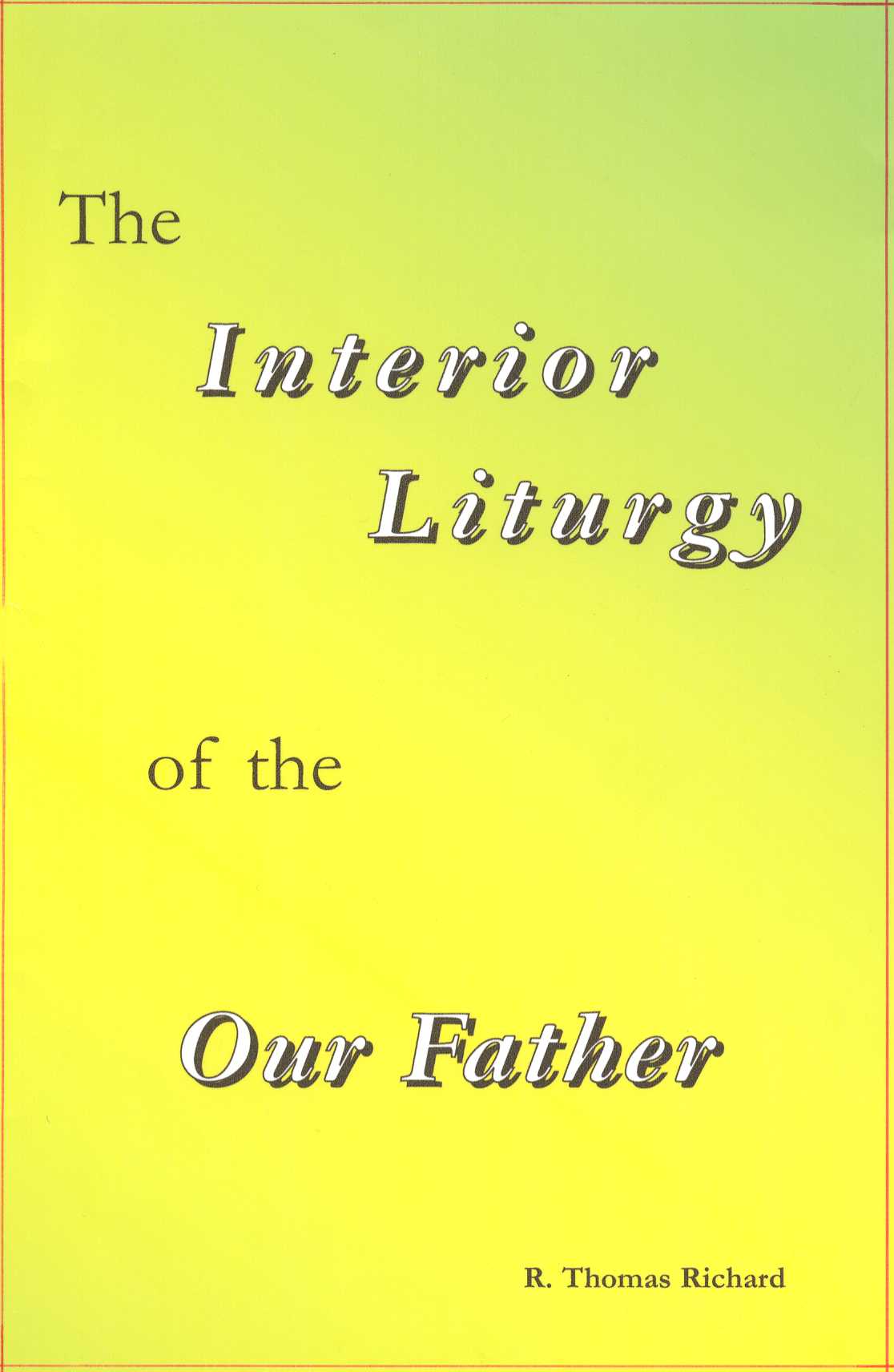
My book The Interior Liturgy of the Our Father is now available in paperback (from Fidelis Presentations) on the Amazon.com website.  I had looked into offering this through Amazon a while ago, to make it easily available around the country, but it seemed too complicated at the time.  A few days ago, to my shock, I went to the Amazon page advertising The Interior Liturgy, and found the Kindle version available of course – but two used paperbacks were for sale by private parties, one for $89, and the other for $500!

I was of course troubled by these prices for these two (used) paperbacks, especially since I have boxes of them new at home and the list price is only $15.  I looked a second time into offering these on Amazon and lo and behold it is much simpler now than before!  Hence the headline: “Now appearing on Amazon – The Interior Liturgy of the Our Father – in paperback.”

The paperback version is the first edition of the book.  In rewriting a second edition for the Kindle and Nook ebooks, I wanted to shorten the first part a bit to allow the reader to more quickly get to the meat of the book: the actual petitions and meanings in the prayer.  I am not sure which I prefer, but the two are not exactly the same.  The paperback has a longer introductory development of the structure and theme of the prayer the Our Father.

Thank You Amazon –

I am really grateful to Amazon for opening the world of authoring, publishing and book-selling to the public, as they have!  This easier access for readers in America and even around the world is a great and wonderful opportunity for the Church, and for the work of the Gospel.  The work of an edifying Catholic novel, or a work of beautiful Christian devotion, or works of solid teaching that the Church needs to hear – all such works of ministry can find their way to hungry hearts many times more easily, more quickly, and less expensively, because of modern technology and companies like Amazon.  The Church urges us all to use the modern possibilities and technologies to spread the Gospel!  And so we should.

A Request –

Readers of any of my books – could you please write a “customer review” for it/them at the Amazon and/or Barnes and Noble website?  A customer review can help a potential new reader make a decision on an author and book he has never heard of before.  I’m not ashamed to ask you – because I really do believe that my books can be helpful for Catholics (and maybe even not-yet-Catholics).  I would not have written them otherwise.  I believe that they will bring forth fruit for the Lord and His Gospel, and so even a word from you could have a share in that fruitfulness.  Thank you…

Thomas Richard

« Newer Posts - Older Posts »

Categories