Posted by: Thomas Richard | August 26, 2010

Potency and Silence; Sterility and Noise

There is much fear and avoidance of silence in our very noisy culture.  Silence and solitude seem to threaten the souls of those who most urgently need them!  Yes, the soul needs the potency of silence and the embrace of solitude, as contradictory as that may sound.  In the openness of silence, in the receptivity of solitude, the soul can finally meet and embrace God the Lover of our souls.

Pope Benedict recently spoke of his closest “travel companions” on the spiritual journey of life – some of whom are among the saints in heaven.  (On the Saints, Companions on the Journey)  He recounted a significant story of St. Augustine:

He and his mother are in Ostia, in an inn, and from the window they see the sky and the sea, and they transcend sky and sea, and for a moment touch the heart of God in the silence of creatures. And here a fundamental idea appears in the journey toward Truth: creatures must be silent so that there will be a silence in which God can speak. This is also true in our time: Sometimes there is a sort of fear of silence, of recollection, of reflecting on one’s acts, on the profound meaning of one’s life. Often preferred is living the fleeting moment, hoping that it will bring lasting happiness. One prefers to live, because it seems easier, with superficiality, without thinking; there is fear of seeking the Truth, or perhaps there is fear that the Truth will find us, will grip us and change our life, as happened to St. Augustine. ‘

Dear brothers and sisters, I would like to say to all, also to those in a difficult moment in their faith journey, those who do not participate much in the life of the Church, or those who live “as if God did not exist” that they not be afraid of the Truth, that they never interrupt their journey toward it, that they never cease to seek the profound truth about themselves and about things with the internal eyes of the heart.

In this culture, so frantic with business and so saturated with noise, the poor and fearful soul can hide from the One who alone can lead us to life.  One can avoid that dreaded meeting with Truth, instead seeking to fill time with entertainment, with fiction, with busyness.  Adam and Eve sought to hide from God, after they sinned against Him (Gen 3).  How foolish we can be!

(Isaiah Ch 55, NAB)

1  All you who are thirsty, come to the water! You who have no money, come, receive grain and eat; Come, without paying and without cost, drink wine and milk!

2  Why spend your money for what is not bread; your wages for what fails to satisfy? Heed me, and you shall eat well, you shall delight in rich fare.

3  Come to me heedfully, listen, that you may have life.

….

6  Seek the LORD while he may be found, call him while he is near.

7  Let the scoundrel forsake his way, and the wicked man his thoughts; Let him turn to the LORD for mercy; to our God, who is generous in forgiving.

8  For my thoughts are not your thoughts, nor are your ways my ways, says the LORD.

9  As high as the heavens are above the earth, so high are my ways above your ways and my thoughts above your thoughts.

10  For just as from the heavens the rain and snow come down And do not return there till they have watered the earth, making it fertile and fruitful, Giving seed to him who sows and bread to him who eats,

11  So shall my word be that goes forth from my mouth; It shall not return to me void, but shall do my will, achieving the end for which I sent it.

12  Yes, in joy you shall depart, in peace you shall be brought back; Mountains and hills shall break out in song before you, and all the trees of the countryside shall clap their hands.

13  In place of the thornbush, the cypress shall grow, instead of nettles, the myrtle. This shall be to the LORD’S renown, an everlasting imperishable sign.

Thomas

Posted by: Thomas Richard | August 21, 2010

The Raincloud is coming….

The Rainclouds are coming… yes, the late rains are coming.

(The Coming Rain - R. Thomas Richard © 2010)

No, far more sweet than warm sunshine is the cloud of grace that comes.

More than the dry embrace, more still than clean rain wetness running down your face,

touching only the outside of things…

His grace that comes,

His late rains like the first and early rains, soak deep –

deep into the bones, deep into the heart, deep to flow life into hands and head and heart –

Life that cries Christ!  Life that pierces all darkness and leaves none left –

Only light.  Only Light, and the eternal sweet Grace that comes.

……………………………………

Deut 11:13  If, then, you truly heed my commandments which I enjoin on you today, loving and serving the LORD, your God, with all your heart and all your soul,
Deut 11:14  I will give the seasonal rain to your land, the early rain and the late rain, that you may have your grain, wine and oil to gather in;
Deut 11:15  and I will bring forth grass in your fields for your animals. Thus you may eat your fill.
Deut 11:16  But be careful lest your heart be so lured away that you serve other gods and worship them.
Deut 11:17  For then the wrath of the LORD will flare up against you and he will close up the heavens, so that no rain will fall, and the soil will not yield its crops, and you will soon perish from the good land he is giving you.

James 5:7  Be patient, therefore, brothers, until the coming of the Lord. See how the farmer waits for the precious fruit of the earth, being patient with it until it receives the early and the late rains.
James 5:8  You too must be patient. Make your hearts firm, because the coming of the Lord is at hand.

Thomas

Posted by: Thomas Richard | August 20, 2010

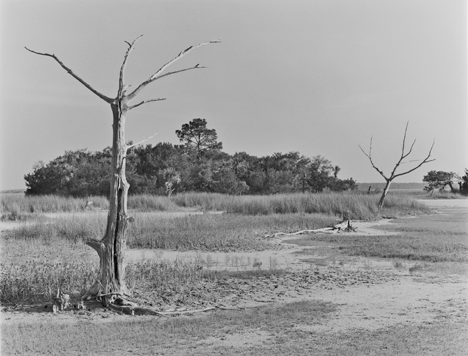
Dialogue in the Wilderness

Dialogue in the Wilderness

Sun-bleach, and salty tides too,

Now bone-white, mere skeletons of trees,

Green no more – but see how they reach!

They speak like prophets in dialogue

even in the wilderness, even in the barrenness,

a prayer heard, that cannot fail.

Hab 3:16  I hear, and my body trembles; at the sound, my lips quiver. Decay invades my bones, my legs tremble beneath me. I await the day of distress that will come upon the people who attack us.
Hab 3:17  For though the fig tree blossom not nor fruit be on the vines, Though the yield of the olive fail and the terraces produce no nourishment, Though the flocks disappear from the fold and there be no herd in the stalls,
Hab 3:18  Yet will I rejoice in the LORD and exult in my saving God.
Hab 3:19  GOD, my Lord, is my strength; he makes my feet swift as those of hinds and enables me to go upon the heights.

Thomas Richard

Posted by: Thomas Richard | August 16, 2010

Holy Mass: Re-Creation or Recreation?

Jesus said, “Behold, I make all things new.”  At every celebration of Holy Mass, Catholics are invited to step into that central moment in time when all creation was made new.  In this moment, time is suspended and the doorway to eternity is opened: human persons stand in the Presence of God the Holy Trinity!  We, the baptized in Christ, are gathered into His heart – into the eternal Love in God, our vocation and destiny.

All this is brought to us in every celebration of Holy Mass!  The eternal is inserted into time; the infinite, into place; the divine, into humanity.  And all so inserted, so gathered, so welcomed, is made new!

Or, is Mass merely recreation?  Is Holy Mass the crucial and transforming and decisive moment of your life (in the Greek, the defining moment or kairos) – or is it merely a nice weekly pastime (another segment of the ever-flowing chronos of time)?  Pastimes can be pleasant, or boring; they remain optional, dispensable, disposable.  They can be chewed up and spit out like distasteful obligations.  They can be passed over, in preference for more attractive options that may present themselves that week.

Recreational use of religion is just that: use.  It is a means to an end, not the end in itself.  The Church believes and teaches that Holy Mass is the “source and summit of the Christian life”!  The Source is our deepest desire – not a mere means to something else!  The Summit is our vocation, our destiny, our intended goal – not merely some nice religious art to pause and gaze at, as we we walk through the gallery of other art-forms.

Recreational use of religion can be critiqued.  “How was Mass today?” Was the music played well?  Was it too loud, or too intrusive?  Was the homily engaging?  Did he keep to his allotted ten minutes?  Did he hold your interest?  Did the priest drag things out – or was he rushed, distracted?  No, recreational religion is already a failure even before the Processional begins!  Mere spectators have already missed the Spectacle!  Mere tourists already missed the Great Attraction!  Like the crowds they press around Him, but they do not touch Him.  One woman touched Him, and was healed.

At the Source and Summit of the Christian Life, the word “lukewarm” does not fit.  Words such as “pleasant”, “nice”, even “very nice” are hollow – insulting.  How does one critique the self-emptying of God become man?  How does one compare the Cross of Christ, and His Resurrection, and the intimacy of divine communion, with “last week” or with the way that other priest does it?  No, spectators and tourists have already missed it.  Though they would press upon Him, they fail to touch Him.  Neither cold nor hot they keep a lukewarm distance, a compromise with God who gave all that they might have life, and have it abundantly.

People of God, do not pass Him by; do not miss the miracle offered to you.  Do not be so distracted with the externals that the essentials are overlooked!  The beauty of a sanctuary radiates not from its design or its furnishings, but from the Life that flows in it.  The holiness of the priest rests not in his vestments and gestures at the altar, but from the consecrated union with Christ that he lives.  The potency of his preaching derives not from style, or delivery, or outline, or humor or drama or any human technique – but from his union with Christ and the Gospel.  Find Christ in the Mass, and you will enter the re-creation; all will become new for you.

Priests and Bishops, regain your zeal!  Find once more your first love!  Ignite those entrusted to you, to the sacred realities so abused and wasted among us!  Without fear, shine the light of truth for your people so tossed and turned by the whims of this dark world!  Be shepherds; feed and tend the sheep.  Preach the truth.  Those who hate Him will hate you; be not afraid.  Teach the truth.  Those who hear Him and follow Him, will follow you; love your people with the love of Christ.

Thomas

Posted by: Thomas Richard | August 4, 2010

On homosexual marriage

Is marriage a human right, which ought not to be denied to any two people?  The question is raised with great passion and zeal these days by homosexuals, who claim that this right of theirs is being denied for no reason beyond mere prejudice.  As full human rights were once denied to slaves and then to descendants of slaves, as rights were once denied to women, now homosexuals are the targets of this injustice.

What a difference faith makes, in the laws of a nation!  And how far has America fallen into moral confusion! Popular acceptance of individual subjective moral standards in place of a universal and objective and binding moral law are breaking apart the moral compass of our country.  Many people can no longer see any reason why marriage ought to be between one man and one woman – so why not move the line a bit to allow homosexuals to marry?

Marriage has a meaning.  Marriage is not merely a civil arrangement, or a legal agreement.  Marriage is certainly not an accidental or arbitrary social construct that can be freely redefined at will.  Marriage is already defined, and it is not subject to reinterpretation.  Marriage is a covenant created by God having a meaning and a message for all of humanity from its origin in the Garden until the Last Day when the Lord comes.  In marriage, a man and a woman enter a unique human expression of the Triune God in whose image they were created.  In marriage, the divine image is proclaimed to all the world, beginning with the children normatively intended in their marriage but extending out to all of society, to all the world.  God is love, and love is intrinsically fruitful.  The truth of marriage is discovered in the truth of being human – and this is revealed finally in God.

No wonder then that as America drifts further and further from God, she becomes more and more dehumanized, barbaric, crude, insensitive, brutal, loud, superficial, and lost.  Man foolishly tries to believe that he can make something right because he wants it to be right, that he can make something true because he wants it to be true.  This is only idolatry, after all.  For all his supposed sophistication, man is merely repeating the foolishness of past millennia: he creates a god to suit himself, and thus destroys his own soul.  Truth is truth, like it or not.  Truth remains, though every man deny it.

God the Holy Trinity revealed love to man on the Cross.  Love gives all for the beloved.  Love empties himself, he gives without limit, he gives to the death – and in this fullness of self-donation, the result is life.  Love is fruitful; love is the bush that burns but is not consumed; love is undying by its nature.  Love, the fullness of self-gift, ends not in death but life – this is the testimony of marriage, and sacred conjugal love: it is not, by its very nature, sterile.  No, just the opposite.  Love is fruitful, a conjugal communion that is not consumed but is fruitful.  In this testimony, the innate sterility of homosexual union is unmasked as the fraud that it is.  Such a counterfeit cannot be rightly called by the same name as that which God gave to us, the prophetic sacrament bearing witness to the inner life of God.  God set His signature on marriage: the word of life.  It is not for man to make it other.

Thomas

Posted by: Thomas Richard | July 23, 2010

Proposal for a Parish Adult Formation Program

The following is a proposal – or maybe more an apologetic, or an exhortation – for a Parish Adult Formation Program.  The darker and more confused the secular world becomes, the more pressing is the need for systematic, comprehensive adult formation in the Faith in parishes and dioceses across the land.  Is anyone listening?  Is anyone awake?

1. Introduction: The importance of adult formation

The Church has collected many documents, studies, exhortations and recommendations concerning the importance of specifically adult formation in the Faith. (1)  One such document is from the Vatican sessions on “Catechesis of Adults in the Christian Community” (1988).  (2)  Among problems, this document notes:

One must admit that in various communities, the formation of adults has been taken for granted or perhaps carried out in connection with certain events, not infrequently in an infantile way. Because certain external or traditional supports are sometimes lacking, a grave imbalance is created insofar as catechesis has devoted considerable attention to children while the same has not happened in the catechesis of young people and adults. (#21)

This imbalance is strikingly widespread and common.  It is not unusual to find parishes with no adult formation program at all, beyond what can be received in Sunday homilies.    Commonly all catechetical concern is toward that of the children, except for the group of adults in RCIA.  The impact of RCIA on the parish as a whole is small, however, and at best brief.  The Sunday homily as a solitary vehicle for substantive and systematic catechesis is not adequate.  The document continues:

In summary, in order for the Good News of the Kingdom to penetrate all the various layers of the human family, it is crucial that every Christian play an active part in the coming of the Kingdom. The work of each will be coordinated with and complementary to the contribution of everyone else, according to the different degrees of responsibility each one has. All of this naturally requires adults to play a primary role. Hence, it is not only legitimate, but necessary, to acknowledge that a fully Christian community can exist only when a systematic catechesis of all its members takes place and when an effective and well-developed catechesis of adults is regarded as the central task in the catechetical enterprise. (#25)

It is worth stressing that it is necessary for a systematic catechesis to exist in the parishes, and this requires “an effective and well-developed catechesis of adults” as the “central task” in the catechetical ministry.

The 1997 General Directory for Catechesis (3), quoting an older Directory, asserts:

Catechesis for adults, since it deals with persons who are capable of an adherence that is fully responsible, must be considered the chief form of catechesis. All the other forms, which are indeed always necessary, are in some way oriented to it.

John Paul II’s teaching, Catechesi Tradendae (4), discusses the catechetical needs of all Catholics and collects us all into the universal right and duty of catechesis:

It must be restated that nobody in the Church of Jesus Christ should feel excused from receiving catechesis. This is true even of young seminarians and young religious, and of all those called to the task of being pastors and catechists. They will fulfill this task all the better if they are humble pupils of the Church, the great giver as well as the great receiver of catechesis.

To actually implement such a parish catechetical program, having adult catechesis as its “chief form” with other forms oriented to it, having adult catechesis as its “central task” is a truly revolutionary challenge.

2.  Program Content

Sacred Scripture and the Catechism of the Catholic Church (or the recent Compendium) must be the two foundational necessities for an adult program.  Both of these are essential.  Both should be offered and accessible to as many adults of the parish as possible.

After the two essential components of the Program noted above, many other offerings could be collected in a category such as “Current Topics in Faith Formation.”  Such a category could include single or a short series of sessions on specific issues of particular relevancy: Catholic Family Life, The Vocation of the Laity, Growing in Prayer, Catholic Sexual Ethics, Catholic Medical Ethics, The Challenge of Islam, Catholic Social Teachings, Catholic Education for Catholic Children, Keeping Home Safe for Catholics, Intermarriage and Catholic Ecumenism, Natural Family Planning in a Catholic Marriage, and other contemporary matters.

For both the essential components and the other offerings, obviously the catechists who teach adults must be selected with great care.  Catechists of adults must have not only technical competence in the field, they must be faithful Catholics having the integrity of a Catholic life.  They must have the teaching skills particularly appropriate to teaching adults, with all the challenges and purposes implicit in adult catechesis.

3.  Integration into Parish Life

It is important that catechesis for adults be available and accessible to as many adult parishioners as possible.  The Adult Program, in other words, should be integrated into the parish calendar and weekly schedule in such a way as to make it available and accessible to as many as possible.  Being the “central task” of the catechetical ministry, it must have a place in the parish schedule that enables its due importance: it is not an “add-on” or an after-thought.  The parish calendar and schedule may need to be revised to reflect the due importance of this ministry, and past priorities may need to be reevaluated in the light of this “central task.”  Such revision may require reeducation of some parish leaders, and this of course must be done with due care and diligence.  However, for the parish to meet its responsibilities, such correction and revision may be required if the current schedule and calendar effectively limit or discourage access.

4.  Parish Support and Involvement

  • The Pastor.  The active support, leadership and involvement of the pastor or at least one resident priest is very important.  If the pastor does not give genuine, sincere and continuing support to adult catechesis it has small likelihood of widespread success.  Pastoral support can include personal endorsements of the need for adult formation, personal announcements at Mass of program offerings, personal attendance at sessions from time to time as his schedule allows, personally teaching some of the sessions, Bulletin articles on the need for continuing adult formation, integration of the need for catechesis and the actual catechetical ministry into homilies, and so on.
  • The pastor can strongly encourage or even require participation in some adult formation sessions particularly of couples being prepared for Matrimony, of couples seeking Baptism or Confirmation of children, of Parish Council members and of other laity involved in other parish works and ministries.  The pastor can help all parish leaders and workers understand the importance of their own continuing formation and participation in adult formation – and thus this realization can begin to extend to all parish groups and ministries.
  • Parish Ministries and Lay Leadership.  Not only the priests, but deacons and all lay leaders of the parish can set the tone in the parish: We are a parish of growing disciples; we take continuing adult formation seriously, personally.  By their personal example and encouragement of all members in their groups, they can help establish this tone and atmosphere.  In this way the acceptance of and participation in adult formation can pervade and permeate the entire parish.

5.  Conclusion

Adult formation is crucial to the mission of the Church and to the local parish.  The Church “exists in order to evangelize,” (5) Pope Paul VI taught.  To ignite this mission in our times, John Paul II called for a “New Evangelization” (6):

Over the years, I have often repeated the summons to the new evangelization. I do so again now, especially in order to insist that we must rekindle in ourselves the impetus of the beginnings and allow ourselves to be filled with the ardor of the apostolic preaching which followed Pentecost. We must revive in ourselves the burning conviction of Paul, who cried out: “Woe to me if I do not preach the Gospel” (1 Cor 9:16).
This passion will not fail to stir in the Church a new sense of mission, which cannot be left to a group of “specialists” but must involve the responsibility of all the members of the People of God. Those who have come into genuine contact with Christ cannot keep him for themselves, they must proclaim him.

And in the light of this call for a new evangelization that must begin in the Church among Catholics, we see that the mission of the Church demands of us attention to the crucial ministry of adult catechesis.  Adults deserve an adult catechesis, an opportunity to encounter Christ in His Word and in the teachings He has entrusted to His Church.   Adults are called in their lay vocation to be “full, conscious and active participants” (7) in the liturgy of the Church – and hence also in the full and personal living of the liturgy in the secular world.  We cannot give to the world what we do not have in our hearts; we cannot bear witness to what we do not understand or even know.  We cannot raise our children in a Faith we do not understand  and love.  We cannot bring light to this dark and darkening culture if we ourselves can hardly see it or articulate it.  We need to know the Faith, and to grow in that wisdom and in that life for the rest of our lives.

Endnotes:

1 A good example: Our Hearts Were Burning Within Us: A Pastoral Plan for Adult Faith Formation in the United States, http://www.nccbuscc.org/education/ourhearts.htm

2 http://www.vatican.va/roman_curia/congregations/cclergy/documents/rc_con_cclergy_doc_14041990_acat_en.html

3 General Directory for Catechesis, http://www.vatican.va/roman_curia/congregations/cclergy/documents/rc_con_ccatheduc_doc_17041998_directory-for-catechesis_en.html

4 Catechesi Tradendae, http://www.vatican.va/holy_father/john_paul_ii/apost_exhortations/documents/hf_jp-ii_exh_16101979_catechesi-tradendae_en.html

5 Evangelii Nuntiandi 14, http://www.vatican.va/holy_father/paul_vi/apost_exhortations/documents/hf_p-vi_exh_19751208_evangelii-nuntiandi_en.html

6 Novo Millennio Ineunte 40, http://www.vatican.va/holy_father/john_paul_ii/apost_letters/documents/hf_jp-ii_apl_20010106_novo-millennio-ineunte_en.html

7 i.e see the Vatican II document Sacrosanctum Concilium 14, http://www.vatican.va/archive/hist_councils/ii_vatican_council/documents/vat-ii_const_19631204_sacrosanctum-concilium_en.html

R. Thomas Richard

Posted by: Thomas Richard | July 12, 2010

The Importance of Reverence in the Church

Below are portions taken from an article by a remarkable Catholic philosopher, Dietrich von Hildebrand, on the crucially important virtue of reverence. I invite you to read it.

+++++++++++++

First, Irreverence:

The irreverent man can never remain inwardly silent. He never gives situations, things and persons a chance to unfold themselves in their proper character and value. He approaches everything in such an importunate and tactless way that he observes only himself, listens only to himself and ignores the rest of being. He does not preserve a reverent distance from the world.

He is either the slave of his pride, of that cramping egoism which makes him a prisoner of himself and blind to values, and leads him to ask repeatedly: Will my prestige be increased, will my own glory be augmented? Or he is a slave of concupiscence, one for whom everything in the world becomes only an occasion to serve his lust.

Thus there are two types of irreverence: that rooted in pride or in concupiscence.

The first type is that of the man whose irreverence is a fruit of his pride, that of the impertinent person. He is the type of man who approaches everything with a presumptuous, sham superiority, and never makes any effort to understand a thing “from within.” He is the “know-all,” schoolmaster type who believes that he penetrates everything at first sight, and knows all things “ab ovo.” He is the man for whom nothing could be greater than himself, who never sees beyond his own horizon, from whom the world of being hides no secret. …….

This man suspects nothing of the breadth and depth of the world, of the mysterious depths and the immeasurable fullness of values which are bespoken by every ray of the sun and every plant, and which are revealed in the innocent laughter of a child, as well as in the repentant tears of a sinner. The world is flattened before his impertinent and stupid gaze; it becomes limited to one dimension, shallow and mute. It is evident that such a man is blind to values. He passes through the world with a blighting incomprehension.

The other type of man who lacks reverence, the blunt, concupiscent man, is equally blind to values. He limits his interest to one thing only: whether something is agreeable to him or not, whether it offers him satisfaction, whether or not it can be of any use to him. ….. Every being is, for him, but a means to his own selfish aim. He drags himself about eternally in the circle of his narrowness, and never succeeds in emerging from himself. ….. He does not approach being as does the first type in an impertinent way, but he is equally closed up within himself, and does not preserve that distance toward being required by reverence; he overlooks all things and seeks only that which is momentarily useful and expedient to him. Similarly, he can never be inwardly silent, or open his spiritual self to the influence of being and allow himself to receive the joy that values give. …. He also is shortsighted, and comes too close to all things, so that he does not give them a chance to reveal their true essence. He fails to leave to any being the “space” which it needs to unfold itself fully and in its proper mode. This man also is blind to values, and to him again the world refuses to reveal its breadth, depth and height.

Reverence:

The man possessing reverence approaches the world in a completely different way. He is free from this egospasm, from pride and concupiscence. He does not fill the world with his own ego, but leaves to being the space which it needs in order to unfold itself. He understands the dignity and nobility of being as such, the value which it already possesses in its opposition to mere nothingness. Thus there is a value inherent in every stone, in a drop of water, in a blade of grass, precisely as being, as an entity which possesses its own being, which is such and not otherwise.
…….
This responsive attitude to the value of being is pervaded by the disposition to recognize something superior to one’s arbitrary pleasure and will, and to be ready to subordinate and abandon oneself. It enables the spiritual eye to see the deeper nature of every being. It leaves to being the possibility of unveiling its essence, and makes a man capable of grasping values. To whom will the sublime beauty of a sunset or a ninth symphony of Beethoven reveal itself, but to him who approaches it reverently and unlocks his heart to it? To whom will the mystery which lies in life and manifests itself in every plant reveal itself in its full splendor, but to him who contemplates it reverently? But he who sees in it only a means of subsistence or of earning money, i.e. something which can be used or employed, will not discover the meaning, structure and significance of the world in its beauty and hidden dignity.
…..
Reverence is the presupposition for every response to value, every abandonment to something important, and it is, at the same time, an essential element of such response to value. Each time one gives oneself to the good and beautiful, each time one conforms to the inner law of value, the basic attitude of reverence is implied. This can be verified by examining moral attitudes on the different levels of life.

The fundamental attitude of reverence is the basis for all moral conduct toward our fellowmen and toward ourselves. Only to the man possessing reverence is revealed the full grandeur and depth of the values which inhere in every man as a spiritual person. The spiritual person as a conscious, free being, as a being who alone, among all the entities known to us, is capable of knowing and grasping the rest of being, and of taking a meaningful position toward it, can only be comprehended by a reverent mind. A being who is able and destined to realize in himself a rich world of values, to become a vessel of goodness, purity, and humility—this is a person. How could one really love another person, how could he make sacrifices for him, if he senses nothing of the preciousness and plenitude which is potentially enclosed in man’s soul, if he has no reverence for this being?
…….
Wherever we look, we see reverence to be the basis and at the same time an essential element of moral life and moral values. Without a fundamental attitude of reverence, no true love, no justice, no kindliness, no self-development, no purity, no truthfulness, are possible; above all, without reverence, the dimension of depth is completely excluded. The irreverent person is himself flat and shallow, for he fails to understand the depth of being, since for him there is no world beyond and above that which is visibly palpable. Only to the man possessing reverence does the world of religion open itself; only to him will the world as a whole reveal its meaning and value. So reverence as a basic moral attitude stands at the beginning of all religion. It is the basis for the right attitude of men toward themselves, their neighbors, to every level of being, and above all to God.

++++++++++++++

The importance of reverence to the entire spiritual and moral life is emphasized in the closing paragraph. It begs the questions, How can we, the Church, facilitate reverence in the members? How can we lead persons into reverence? Can we “teach” reverence? And if so, how? Is it possible that we work against reverence in the Church in some ways, thus sabotaging our own purpose and mission? If so, how could we be doing this – and if we unfortunately are, how can we stop and change direction?

I’m interested in your thoughts.

Thomas

Posted by: Thomas Richard | June 1, 2010

The One Thing Necessary

Lk 10:38  Now as they went on their way, he entered a village; and a woman named Martha received him into her house.
Lk 10:39  And she had a sister called Mary, who sat at the Lord’s feet and listened to his teaching.
Lk 10:40  But Martha was distracted with much serving; and she went to him and said, “Lord, do you not care that my sister has left me to serve alone? Tell her then to help me.”
Lk 10:41  But the Lord answered her, “Martha, Martha, you are anxious and troubled about many things;
Lk 10:42  one thing is needful. Mary has chosen the good portion, which shall not be taken away from her.”

One thing is needful.  One thing is necessary, and if the one thing is missing then everything goes wrong.  Popular reinterpretations of this passage, of course, are not so black-and-white.  I’ve heard this Gospel section presented many times, but with the “one thing” of Luke’s version somehow morphed into an easier-to-receive “two things”.   According to the new version, some of us are by nature worker types like Martha and others of us are by nature prayerful Mary types – and isn’t it wonderful that God loves us all.

It is harder to hear Jesus.  But He has something to say that can bring us into His life, if we are willing to listen to Him and learn.  It is necessary to spend time at the feet of Jesus, listening to Him.  It is necessary to have an interior life, a life of prayer, a contemplative center out of which good works can flow.  It is necessary to have quiet time with the Lord, resting in Him, leaning upon His breast and listening to His heartbeat.  It is necessary to find union in Him, lest we become busily absent from Him.

Yes, Martha interiorly left Jesus in her attempt to serve Him!  But look at the results: she became distracted with her “much serving”.   She felt that the Lord stopped caring about her: “Do you not care that my sister has left me to serve alone?”  And then, she presumed to tell Jesus what to do: ” Tell her then to help me.”  This is what happens when our “serving” gets ahead of our prayer life.  Prayer, an interior life, a true relationship with Him in the heart, is necessary.

A true, authentic, vital, sincere and habitual life of prayer is necessary.  Prayer is our union with Him, it is our life in Him – and apart from Him we can do nothing.  This is true for us all – for priests, for bishops, deacons, for laity both men and women.  Apart from Him we can do nothing that has being, that lasts into eternity, that will withstand the fire of testing.

Habitual busyness is a dangerous temptation – and when it is “busyness” for the Church, for good religious cause, it is most dangerous because then we justify it and will not recognize the danger.  Martha saw no danger in busyness for the Lord Jesus!  She was preparing for His visit!  She had good works to do for Him!  But in her busy distraction, she left Him to seek and to justify herself.  Mary chose the better portion, which shall not be taken from her.  In her quiet union with the Lord, she gathered treasure to carry with her into eternity.

The Church today needs prayer.  Who will meet with the Lord in prayer?  Who will pray for our priests and bishops?  Who will pray for our families?  Who will pray for our Catholic politicians?  Who will pray for those among us who have no idea how to pray, or the value of prayer, or their desperate need for the fruits of prayer in their own lives?  Who will pray for overflowing showers of graces to pour upon the Church and give us life?

Thomas

Posted by: Thomas Richard | May 13, 2010

On the Feast of Our Lady of Fatima

photo by Thomas Richard

Sr. Lucia was one of the three children who were visited by Mary in the apparitions of Fatima.  Late in her life she wrote a book, “Calls” from the Message of Fatima.  The book is remarkable, and is itself a call to repentance and conversion so greatly needed in our time.  The beginning chapters of her book are titled “Calls” – to Faith, to Adoration, to Hope, to love God, to Forgiveness, to Prayer, to Sacrifice, ….  The list and the chapters go on and on, calling this darkening world to the saving light of Christ.

Is anyone listening?  Is the Church listening?  Certainly some in the Church are listening, but it seems that many are content to live day to day as if tomorrow will surely come – like passengers on the Titanic, unaware of the giant iceberg dead ahead of them.  The world continues to find shelter not on the foundation of Rock, but in a house of cards – and the winds are growing.

Pope Benedict XVI, in a Papal Press Conference En Route to Portugal, spoke of the meaning of the message of Fatima for us today:

For us, Fatima is a sign of the presence of faith, of the fact that it is precisely from the little ones that faith gains new strength, one which is not limited to the little ones but has a message for the entire world and touches history here and now, and sheds light on this history. In 2000, in my presentation, I said that an apparition – a supernatural impulse which does not come purely from a person’s imagination but really from the Virgin Mary, from the supernatural – that such an impulse enters into a subject and is expressed according to the capacities of that subject. The subject is determined by his or her historical, personal, temperamental conditions, and so translates the great supernatural impulse into his or her own capabilities for seeing, imagining, expressing; yet these expressions, shaped by the subject, conceal a content which is greater, which goes deeper, and only in the course of history can we see the full depth, which was – let us say – “clothed” in this vision that was accessible to specific individuals.

Consequently, I would say that, here too, beyond this great vision of the suffering of the Pope, which we can in the first place refer to Pope John Paul II, an indication is given of realities involving the future of the Church, which are gradually taking shape and becoming evident. So it is true that, in addition to moment indicated in the vision, there is mention of, there is seen, the need for a passion of the Church, which naturally is reflected in the person of the Pope, yet the Pope stands for the Church and thus it is sufferings of the Church that are announced.

The Lord told us that the Church would constantly be suffering, in different ways, until the end of the world. The important thing is that the message, the response of Fatima, in substance is not directed to particular devotions, but precisely to the fundamental response, that is, to ongoing conversion, penance, prayer, and the three theological virtues: faith, hope and charity. Thus we see here the true, fundamental response which the Church must give – which we, every one of us, must give in this situation. As for the new things which we can find in this message today, there is also the fact that attacks on the Pope and the Church come not only from without, but the sufferings of the Church come precisely from within the Church, from the sin existing within the Church. This too is something that we have always known, but today we are seeing it in a really terrifying way: that the greatest persecution of the Church comes not from her enemies without, but arises from sin within the Church, and that the Church thus has a deep need to relearn penance, to accept purification, to learn forgiveness on the one hand, but also the need for justice. Forgiveness does not replace justice.

In a word, we need to relearn precisely this essential: conversion, prayer, penance and the theological virtues. This is our response, we are realists in expecting that evil always attacks, attacks from within and without, yet that the forces of good are also ever present and that, in the end, the Lord is more powerful than evil and Our Lady is for us the visible, motherly guarantee of God’s goodness, which is always the last word in history.

Thomas

Posted by: Thomas Richard | April 16, 2010

How Close is the Day?

When the angel came to Zechariah, the future father of John the Baptist, to tell him of Elizabeth’s surprising motherhood and the remarkable vocation of his coming son, the angel said this:

Lk 1:16  “And he will turn many of the sons of Israel to the Lord their God,
Lk 1:17  and he will go before him in the spirit and power of Elijah, to turn the hearts of the fathers to the children, and the disobedient to the wisdom of the just, to make ready for the Lord a people prepared.”

The phrase “to turn the hearts of the fathers to the children” echoed in my ears as I pondered the truly massive U.S. debt that is the inheritance of our children and grandchildren for generations.  And the debt continues to increase, and the interest on the debt continues to increase, and the increasing burden continues to be loaded on their backs.  Meanwhile we – their “fathers” – seek to protect and expand our entitlements, prop up our inflated home values, bail out our corrupt investors and investment managers, and expand our over-paid and over-benefited army of bureaucrats.

The phrase “to turn the hearts of the fathers to the children” haunts me.  Abortion funding increases, child pornography increases, child abuse continues.  Our children are abused not only individually, sexually, by predators of every stripe and origin.  Our children are abused corporately, institutionally, in schools that warp their minds to the progressive agenda, in movies and music and television that deaden their souls with immorality and atheism.

But can the children not find solace, protection and righteous direction in their homes, and from their mothers and fathers?  Our families have been so fractured by divorces and remarriages,  so preoccupied with material and temporal concerns, so distracted  by perceived economic “needs,” so poorly formed themselves in the saving Faith of the Church – so persistently busy! – that the children in many cases are left to raise themselves in front of a television, or later with their friends.

When will they come – those in the spirit and power of John – to turn the hearts of fathers to their obligations before God?

May the Lord keep us, His Church, from the unbelief of Zechariah when he heard this from the angel.  The passage continues:

Lk 1:18  And Zechariah said to the angel, “How shall I know this? For I am an old man, and my wife is advanced in years.”

The Church has become “old and advanced in years” in many respects, in our time.  What are the concerns of the typical parish in the U.S.?  What are our parishes and parishioners working toward?  Is it evangelization, with the zeal and vigor of young adulthood?  Is it faith formation for adults and parents, with the humble hunger of young believers to grow in the Truth?  Or rather are they the preoccupations of the “old and advanced in years”: maintenance, preserving the status quo, keeping the grounds pretty and our reputation in the “community” intact?  Have we not lost our first love?  Where is the passion; where is the life?

Zechariah was unable to speak, because of his unbelief, until the birth and naming of John.  Is our prophetic silence the same judgment?  Will the Church not awaken until the very end?  Let us please pray.  We need supernatural intervention; too many of our leaders are dozing, content with their managing and their buildings and their budgets.   We have become “evangelized” by the world, secularized and socialized, hardly able even to see that there is a problem!

Meanwhile, the symptoms increase and the darkness advances.  Pray, brothers and sisters.  Pray!  Daybreak is coming!

Thomas

« Newer Posts - Older Posts »

Categories