Posted by: Thomas Richard | July 24, 2017

Simple Guidelines for Profound and Effective Prayer

Introduction

To describe the simple guidelines for vocal prayer, in a few words, is easy:
— Slow down.
— Pray attentively.
— Pray with fervent devotion.

I’ll expand on the few words a bit later; first let’s consider what prayer is, and why we ought to pray. Then, the question of how to pray becomes seen in the light it deserves. It is fundamentally, crucially, even urgently important to pray well.

What is Prayer?

What is prayer? There are several ways to describe what prayer is; each of the descriptions below are worth some time to listen and to consider. They all come from men and women of prayer – men and women who have experienced what they describe. They are not academics; they are not (merely) theologians; they are witnesses. They have lived lives of prayer; they have experienced, and they know of what they speak.

The briefest definition of prayer I have heard is from St. John Vianney: “Prayer is nothing other than union with God.” (“Catechetical Instructions” – Catechism on Prayer, Ch. 8.)

Another saint of the Church, Therese of Lisieux, wrote: “For me, prayer is a surge of the heart; it is a simple look turned toward heaven, it is a cry of recognition and of love, embracing both trial and joy.”  (Catechism # 2558)

And more from the Catechism: “Prayer is the raising of one’s mind and heart to God or the requesting of good things from God.” [St. John Damascene] But when we pray, do we speak from the height of our pride and will, or “out of the depths” of a humble and contrite heart? [see Ps 130:1] He who humbles himself will be exalted; [Cf. Lk 18:9-14] humility is the foundation of prayer. Only when we humbly acknowledge that “we do not know how to pray as we ought,” [Rom 8:26] are we ready to receive freely the gift of prayer. St. Augustine wrote, “Man is a beggar before God.” (Catechism # 2559)

The Catechism also includes this: “Christian prayer is a covenant relationship between God and man in Christ.” (Catechism # 2564) “In the New Covenant, prayer is the living relationship of the children of God with their Father who is good beyond measure, with his Son Jesus Christ and with the Holy Spirit.” (Catechism # 2565)

If prayer is truly prayer – if God is truly present with the one praying – if prayer is not merely talking to oneself, but in truth “union with God” – then prayer has a supernatural and divine dimension, pervading the natural and human dimension of the person in prayer. When we pray, we are not alone! Prayer is a union, a communion, a living relationship with God, an embrace of love.

If prayer is truly prayer, it is lived and experienced in a process – a growing, advancing process – a journey – a “living relationship of the children of God” with God Himself, the Holy Trinity. If we have a life of prayer, it is growing – and we are growing, in the life of prayer. If we have a life of prayer, we are on a journey of prayer in Him, to Him, with Him and with all who are in Him with us. To have a life of prayer, we must have times of silence and solitude with God alone. And with God alone, we are never alone.

How then are we to pray?

— Slow down.
— Pray attentively.
— Pray with fervent devotion.

These three requirements for praying especially vocal prayer well, are mutually linked. If we don’t slow down, it is very easy to pray unconsciously, merely reciting words out of memory, possibly day-dreaming and mentally a million miles distant from where our bodies are. Such is not praying! St. Teresa of Avila, writing to help her sisters in the Carmelites to grow in prayer, wrote of the very first steps:

… if it is prayer at all, the mind must take part in it. If a person neither considers to Whom he is addressing himself, what he asks, nor what he is who ventures to speak to God, although his lips may utter many words, I do not call it prayer. Sometimes, indeed, one may pray devoutly without making all these considerations through having practiced them at other times. The custom of speaking to God Almighty as freely as with a slave–caring nothing whether the words are suitable or not, but simply saying the first thing that comes to mind from being learnt by rote by frequent repetition–cannot be called prayer: God grant that no Christian may address Him in this manner. I trust His Majesty will prevent any of you, sisters, from doing so.
Interior Castle, 1st Mansions, Ch. 1, #9)

We must pray attentively! We must be attentive to who is praying, and to whom I am praying, and what it is that I am praying. When I am in prayer, I must be conscious of reality: without pretense or role-playing, without affectation, posturing or posing but in simplicity and sincerity. God knows me inside and out! He is not impressed with artificial flowers or theatrical oratory:

Thus says the LORD: “Heaven is my throne and the earth is my footstool; what is the house which you would build for me, and what is the place of my rest?
All these things my hand has made, and so all these things are mine, says the LORD. But this is the man to whom I will look, he that is humble and contrite in spirit, and trembles at my word. (Isa 66:1-2)

I am praying; it is to almighty God that I am praying; and this is what I am saying in prayer to Him. Let us pray slowly enough that we can be confident that we are praying attentively, and devoutly.

Yes, let us pray with devotion – honest, sincere, full-hearted devotion. Devotion is consecration – commitment – self-offering, self-gift, self-donation according to these words, the words of my prayer, binding me to God and with Him in our covenant in Christ. As cited above from the Catechism, prayer is a “covenant relationship between God and man in Christ.” Christ has died to open the way for our union – to seal our union by a covenant in His sacred blood.

So, for example, if I pray, “Our Father…,” do I commit myself and consecrate myself to be brother or sister to all who are of “our Father”? Do I see us all as called into Him with one another? Is my heart big enough, and wide enough, to hold all who are of “our Father”? And is He held in faith as my Father? Am I living a life worthy of His Name, which I claim to possess in Him by faith? Do I mean it, in other words, when I say, “our Father”? If I do not mean the words, as I say and remember this holy prayer, then my prayer ought to be for the grace and mercy of God to help me grow into meaning them, in sincerity and truth.

The life of prayer is a process, a life of growing and maturing in Him. He calls us all to holiness and to the perfection of charity. (CCC # 2013) The journey to holiness is the journey of prayer, a life of prayer and the living of the fruit of prayer: works of holy charity. Let us slow down enough to listen and to learn the truth of ourselves, and the truth of God. He calls us to a real, authentic union with Him. He created us for this union! And our hearts will be restless, until they find their rest in Him. (St. Augustine)

Let us resolve to make our prayer – even our most familiar vocal prayers of the Church – the Our Father, the Hail Mary, the Glory Be – let us make our prayers true: truly from the heart, true in conscience. Let them be meant, and believed, every word. As St. Francis of Assisi said, very near the end of his life, “Brothers, finally, let us at last, begin.”

Thomas Richard
 

Posted by: Thomas Richard | June 26, 2017

Our Need for Prayer

Mother Teresa troubled the West when she noted that for all the wealth of our materialism, we are victims and perpetrators of a deeper poverty than the material poverty she knew back in her beloved India.  She saw among us – citizens of a developed nation, a modern and advanced society – persons rejected, abandoned, alone.  She spoke of babies rejected and aborted because they would require care, and love, and sacrifice.  She spoke of the “disease” among the living of persons uncared for, unloved – a cultural poverty of love:

The greatest disease in the West today is not TB or leprosy; it is being unwanted, unloved, and uncared for. We can cure physical diseases with medicine, but the only cure for loneliness, despair, and hopelessness is love. There are many in the world who are dying for a piece of bread but there are many more dying for a little love. The poverty in the West is a different kind of poverty — it is not only a poverty of loneliness but also of spirituality. There’s a hunger for love, as there is a hunger for God.

― Mother Teresa, A Simple Path: Mother Teresa

There can be a kind of love without God – but it is thin, shallow, transient.  Such love is never enough; it is barren, untrustworthy, unfaithful. The true hunger of persons for love is the deep longing for home, for our Origen, for our Destiny, for the meaning and reason for our very being.  We cannot know such love apart from sacrifice, from self-gift, and from the receiving of the gift of another. Love completes us, and the only love that can still the deepest longing of our hearts, is the love that completes us to finality, to perfection, into timeless peace.  “There’s a hunger for love, as there is a hunger for God.”

Christians have the greatest promise ever dreamed of in the history of all creation, and it is no dream: it is real, a real promise, an assurance, a treasure waiting to be received and gathered into each precious self, each person, each soul.  God is seeking to be sought.  God is seeking to be found.  God is waiting to be asked; He is the flame of divine and eternal love, waiting to set ablaze human hearts grown cold in guarded and lonely chambers of isolation.  God waits to pour life into souls lingering or wandering in the shadow of death, if we will but seek Him!

Prayer is our call to God, the ever-near God who waits.  Prayer is the journey to life, the journey to Him.  It is the journey to Him, all the while always with Him.  We cannot take a step to Him, except with Him – indeed, except in Him, and He in us, an ever-present Companion.  He reveals Himself only when it is time, and only enough to enable our strength for the day.  He is calling us to holiness!  He is calling us to life, to love, to communion – and because He calls us to Himself, the hunger in our hearts is deep, and strong: we must respond.

The Journey of Prayer

The journey of prayer then is a journey of response to this place in our hearts made for God, made by God, satisfied by no other love but holy love, of and for the one true God.  The journey of prayer is a journey of meeting with God, of communion with Him, progressively deeper and higher in communion with Him.  Therefore the path both descends, deeper and deeper into our own souls, and ascends, higher and higher to Him.  The journey of prayer proceeds with greater and greater engagement with God, if and as we continue to grow in the interior life of prayer.  In the very depths of the soul is I myself – who I am – my own unique name as God knows me and has created me.  If then, in my ascent to Him in prayer, I come finally to meet Him there, in the depths and center of my soul, then my prayer has reached its rightful end, even here on this earth and in this body.

Stages, or Grades, of Prayer

  •  Vocal Prayer

The journey of prayer proceeds in stages: Vocal Prayer, Meditation, Contemplation.  We begin with vocal prayer – either “formula” vocal prayers such as the Our Father, the Hail Mary, the common prayer of blessing before meals, the Glory Be, and so on, or “spontaneous” vocal prayers that are prayers simply prayed in our own words.  This is the way we typically begin to pray – words spoken, directed to God either directly or through the intercession of some saint.  For many people, this is also the only way that praying is understood!  But prayer includes more, much more, than “words spoken, directed to God” directly or indirectly.

The essential requirements to pray vocal prayer well, and fruitfully, are to pray slowly, carefully, attentively, with devotion:

  1. pray with careful attentiveness, slowly, giving careful attention to what is being prayed: to every word offered in the prayer,
  2. pray with reverent devotion and commitment to the words prayed; with a faithful sincere heart, with careful intent to be obedient to the meaning, the words, the intention of the prayer.
  • Meditation

If we advance in prayer, we advance to include meditation, or mental prayer, as a way of praying along with our vocal prayers.  We never “outgrow” the beautiful written vocal prayers of the Church – indeed the Our Father is our model for prayer, the perfect prayer.  But vocal prayer, prayed well, invites us to pray better – more deeply – more completely – with our whole mind and heart.  Vocal prayer prayed well invites us into meditation.

Meditation in the Christian sense is the intentional engagement of the mind – thus “mental prayer” – with the works and words of God.  Fitting for meditation would be portions of Holy Scripture, for example: devoting time to carefully listening to a portion of Scripture, seeking to hear and understand it as fully and deeply as possible, seeking to fully open one’s own mind and heart to this passage which is “of God”.  In this way we seek to know Him more and more, in truth, and to understand His will and His ways, so as to love Him with our whole mind, and heart, and soul – by seeking to live in obedience to His will and His ways.

As vocal prayer has two “kinds” – formula and spontaneous – so mediation has three “kinds”.  The three kinds of meditation are usually experienced in a sequence, each progressive kind being “deeper” and more “simple” than the preceding one: first discursive meditation, or effort to understand or grasp with the mind, using reasoning; then affective meditation, with more intense affect of the heart; and finally the prayer of simplicity, deep and intense engagement with great focus on matters of simplicity, purity, and mystical profundity.

  • Contemplation

The last-listed “kind” of meditation, the prayer of simplicity, might be called (and has been called) “acquired contemplation,” but it is not yet true contemplation – it is still meditation.  All of the grades or stages of prayer listed so far belong in the category of ascetical prayer; the kinds of prayers of contemplation, rightly understood, belong in the category of mystical prayer.

Ascetical and mystical prayer are radically, importantly and significantly different.  Ascetical prayer can be prayed with ordinary habitual grace – the grace common to all in “the state of grace” and fellowship with Christ.  All Christians in the state of grace given in Baptism can pray in the mode of ascetical prayer – all kinds of vocal prayer and all kinds of Christian meditation.  Mystical prayer is different; contemplation, rightly understood, is different.  Contemplation is a work of God the Holy Spirit not a work of man; it is initiated and caused by actual grace (not caused by, but still requiring the presence of ordinary habitual grace) infused into – given to – the soul by God’s initiative.  Man cannot “do” contemplation; it is given to him.

There are five “kinds” of the mystical prayer, contemplation, all connoting stages of deepening, increasing spiritual union with God: contemplation as first experienced is called simply “infused contemplation.”  The next grade of contemplation is called “the prayer of quiet,” after that, “the prayer of union,” and then, “the prayer of conforming union,” and finally, “the prayer of transforming union.”  This last grade or stage of contemplation, the transforming union, is also called the spiritual marriage of the soul with God. It is identified with the seventh mansions of St. Teresa’s Interior Castle; it is the highest level of union with God possible in this life.

Concluding Thoughts

In the beginnings of prayer – vocal prayer, using prayers such as the Our Father, the Hail Mary, the whole Rosary – we are beginning a conversation with God.  In this beginning, it may be that we do all the talking, and possibly not even wait for God to respond!  But this beginning of a conversation is intended by God to grow, to develop, to mature.  The fullness of development, of maturity, of conversation with God is in the higher levels of contemplation, especially the last kind of prayer listed here, the prayer of transforming union.  I hope that this brief post on the journey of prayer can encourage you to pray more, to pray with greater attention and devotion, to expand your praying into the prayers of meditation upon Holy Scripture, and on to the threshold of holy contemplation, and beyond.

“Assignment for the Learner”

The Our Father is an excellent prayer (it is the perfect prayer!) to pray, and to meditate upon in prayer.  I have a guided meditation on this prayer on my website, linked here:

An Interior Pilgrimage for the Soul

The first page (the link above) is an introduction, ending with a link to a page beginning the meditation/pilgrimage.  Try a plan of one page of the pilgrimage per day, until you complete the whole Our Father – and for the rest of each day, focus on the whole prayer the Our Father, especially the verse/petition especially highlighted for that day.

There is a space for comments/responses at the bottom of each web page – I’d appreciate hearing from you any questions or comments, especially about any way or ways this guided meditation has been helpful to you.

Learn more about the art and the science of prayer!  I list some resources below:

Resources:

  1. Spiritual Theology, by Fr. Jordan Aumann, O.P.  Pages (on Prayer): 221-248.  This book can be read on-line, for free.  Fr. Aumann discusses all of these grades of prayer.  An on-line copy is HERE
  2. The Ordinary Path to Holiness, by R. Thomas Richard, Chapter 4: Growing in Holiness: Prayer.  Sorry, no copies available free on-line, only for purchase, paperback or Kindle reader.  (See Amazon: LINK  ; Author’s review: LINK)
  3. Encountering Christ in Holy Scripture with Lectio Divina, by R. Thomas Richard.  Sorry, no copies available free on-line, only for purchase for the Kindle reader.  (See Amazon: LINK )
Posted by: Thomas Richard | May 31, 2017

Sanity At Last re: “transgendered children”

Here’s a good, solid, professional assessment on one of the more recent examples of the insanity sweeping the nation.  First they rejected God.  This allowed them to reinvent truth, moral truth in particular, and moral truth concerning sexual activity especially.  This not being enough, they decided to reinvent marriage.  But wait!  Why not “gender identity” too?  And how about the children…. why not start them young…. very young….

This article sheds some light, and some refreshing “normal sanity” on the subject.  Please read it:

Gender Ideology Harms Children

The opening paragraph, on the Homiletic & Pastoral Review website:

The American College of Pediatricians urges healthcare professionals, educators and legislators to reject all policies that condition children to accept as normal a life of chemical and surgical impersonation of the opposite sex. Facts—not ideology—determine reality. The following 8 points and clarifications are herewith provided in order to help priests and curators of souls some guidelines with which to counsel people properly. An earlier version of this statement was published by the American College of Pediatricians (the College) on its website in August, 2016. The College is a national organization of child health professionals that is rooted in science and natural law. Fr. David Meconi, S.J., received permission from the College to reissue it in HPR. Please keep the American College of Pediatricians and its good work in your prayers.

Posted by: Thomas Richard | March 14, 2017

“Maintenance to Mission” – Title in Search of Reality

It is a title – do a Search for the term on computer! – a title of a book, a plan for evangelization, a parish goal, parish and diocesan project titles, conference speaker’s presentations, focus groups…. The best part of any plan, project or book using this term that I have seen remains, the title itself. I don’t know if any use of the title has ever met the potential power of the term itself! The term itself is overflowing with sorrowful importance because it convicts us of a far-too-usual grave fall – parishes and dioceses fallen into self-focused “maintenance mode.” And it is brimming over with hopeful significance because it points parishes and dioceses so simply to what ought to be driving us all: Christian mission!

The Archdiocese of Boston has on their website a one-page diagnostic instrument for parishes and dioceses, which helps to answer the question: Are we maintenance-driven, or mission-driven? ( LINK[sorry: edited to remove Link which no longer works])  The diagnostic is simply these Maintenance or Mission indicators:

1. Involvement:
– Maintenance-driven: Activity! getting people involved in events, activities in parish.
– Mission-driven: Helping all people encounter Jesus and experience conversion through their involvement at the parish and outside.
2. Roles:
– Maintenance-driven: Forming individuals to take on parish leadership roles.
– Mission-driven: Forming individuals to discern their charisms and God-given vocations.
3. Commitment:
– Maintenance-driven: Getting parishioners to give more time, talent, and treasure to the parish.
– Mission-driven: Helping individuals commit their entire life to Jesus and live out that commitment daily.
4. Sustaining:
– Maintenance-driven: Sustaining the current parish structures & number of people.
– Mission-driven: Sustaining a culture of discipleship, nurturing and sustaining the work of conversion in individuals.
5. Catechesis:
– Maintenance-driven: Relying solely on catechesis as the means of transmitting the faith.
– Mission-driven: Transmitting the faith through pre-evangelization, initial proclamation and then catechesis in a systematic way.
6. Formation:
– Maintenance-driven: Providing formation for ministries exercised only for the parish.
– Mission-driven: Answering the outward call of the parish by providing formation for individuals to both take part in parish ministries and transform the secular world.
7. Communication:
– Maintenance-driven: Communicating in “insider” language.
– Mission-driven: Communicating in language both “insiders and outsiders” can understand.

Taken seriously, applied honestly, these indicators can begin a real, authentic renewal in a parish – a transformation toward a truly life-giving embrace of our Baptismal vows, our Confirmation empowerment, our Eucharistic communion, and the rightful living out of whatever life Christ has entrusted to each of us, in Him.

The mission-driven parish addresses what is essential, foundational. The maintenance-driven parish is preoccupied with what is on the surface, immediate. The squeaky wheels need grease. The Mass lasts too long. The parking is inadequate. The electric bills are too high. Contributions are not meeting expenses. Too few members show up for anything except food: “feed them and they will come.” The music is too loud, too protestant, too unknown, too Latin, too many stanzas, too fast, too slow, too much, too little. We need to be youth-friendly. We need to be family-friendly. We need to be senior-friendly. We need to be Hispanic-friendly. We need to be friendly. We need this; we need that; we need to be more Catholic; we need to update; we need… What do we need?

We need Christ! We need the life of Christ! We need Faith! We need to know, to love, to live the Catholic Faith! We need a life of prayer! We need the living, abiding, teaching and leading Holy Spirit. Go back to those Mission indicators, one at a time, and listen to what every parish and diocese needs! At the center, the heart of a parish must be Christ and His mission, His life. Or else, what are we? Why are we, if not because of Him? If not because of Him, and in Him, and toward Him, we are …. what? A private club with “members”? A business with “customers”? A habit? A hobby? A Judgment Day insurance policy? A drug for tranquilizing personal guilt? No, He went to the Cross for much more: to give life, and life abundantly. In Him we find life.

Posted by: Thomas Richard | March 3, 2017

Praying Scripture – Lectio Divina (part I)

The Catechism teaches much about prayer that can help us to grow in prayer. It can help us know why we should grow in prayer – why we should want to grow in prayer. To begin this post, let us observe one truth about prayer that we need to know from the beginning: prayer takes effort, it can cost us to pray, it is beautiful and necessary that we pray – but know this, prayer is a battle.

Prayer is a battle.
CCC 2725 Prayer is both a gift of grace and a determined response on our part. It always presupposes effort. The great figures of prayer of the Old Covenant before Christ, as well as the Mother of God, the saints, and he himself, all teach us this: prayer is a battle. Against whom? Against ourselves and against the wiles of the tempter who does all he can to turn man away from prayer, away from union with God. We pray as we live, because we live as we pray. If we do not want to act habitually according to the Spirit of Christ, neither can we pray habitually in His name. The “spiritual battle” of the Christian’s new life is inseparable from the battle of prayer.

Prayer is a battle first against ourselves: we can resist prayer, consciously and subconsciously. And prayer is a battle against the enemy of all souls, including yours and mine, the evil one the devil. To defeat the enemy, within and without, it helps to have a plan. A ancient plan for prayer, that reaches back at least to the early centuries of the Christian Church, is “Lectio Divina”, “Sacred Reading” of Holy Scripture.

Lectio Divina is a method, a system, an attitude, a plan with which we can listen more carefully to matters and truths of God, Sacred Scripture especially, so as to receive – or grow in – holy faith. It is a process of four steps:

  • lectio – listening to a passage of Scripture,
  • meditatio – meditating upon that passage,
  • oratio – praying in accord with the truths of that passage,
  • contemplatio – resting in the contemplation of those truths.

In each of these four steps, the battle awaits! In each of the four, who will be the subject of attention: myself and my thoughts and opinions, or God and His divine Truth? Indeed, will I even wage the battle to be attentive to anything? Maybe I will let my mind wander like a butterfly from flower to interesting flower, with no commitment to any of them. Maybe I will day-dream, randomly, forgetting the flowers altogether. But if I am cooperative with this ancient practice of Lectio Divina, and if I am attentive to Him and His Truth, wonderful things can happen, in my praying Holy Scripture.

Lectio Divina, in the form we are discussing, dates to the 12th century and a Carthusian Abbot Guido II. In about AD 1150, he wrote to a fellow monk of “A Ladder of Four Rungs by which we may well climb to heaven.” Here he described a method of 4 steps by which one could practice Lectio Divina – literally “sacred reading” – in a disciplined way. Dom Guido wrote:

“This is the ladder Jacob saw, in Genesis [“Jacob’s Ladder”], that stood on the earth and reached into heaven, on which he saw heavenly angels ascending and descending, with God leaning upon the ladder. ……
Understand now what the four staves of this ladder are, each in turn.

  • Lectio – Reading, is busily looking on Holy Scripture with all one’s will and wit.
  • Meditatio – Meditation, is a studious insearching with the mind to know what was before concealed through desiring proper skill.
  • Oratio – Prayer, is a devout desiring of the heart to get what is good and avoid what is evil.
  • Contemplatio – Contemplation, is the lifting up of the heart to God tasting somewhat of the heavenly sweetness and savour.”

Essentials Needed in Praying Scripture
To point out the obvious – no plan, method or process of praying Holy Scripture can insure spiritual success without supernatural intervention. That is, we need grace – the grace, the presence, the active assistance of the Holy Spirit whose “assigned ministry” (so to speak) by God the Holy Trinity is to lead, to guide the members of His Church “into all the truth.” We need to listen “in the Spirit” to hear the words written “in the Spirit” concerning the Word, the Son, the Lord Jesus Christ.

A second obvious factor that must be present is the human person listening. He must not be merely “present” physically – more than “body-presence” is needed. He must be there, as St. Teresa of Avila said, with both attention and devotion. He must be there not in the audience, sitting in the dark in the last row of the auditorium, so to speak: he needs to be close to the words written and resting on his table or in his lap. He must be close, his life on the line; his mind alert and attentive to come to know ever more of God and His Truth – his will, his heart quick with assent to do all that he hears God’s will that he do. Attention and devotion are the offerings required at this altar, indeed the self-offering – the return of one’s self to God our Creator and Father – pleases God, as He wrote:

Is 66:1  Thus says the LORD: “Heaven is my throne and the earth is my footstool; what is the house which you would build for me, and what is the place of my rest?
Is 66:2  All these things my hand has made, and so all these things are mine, says the LORD. But this is the man to whom I will look, he that is humble and contrite in spirit, and trembles at my word.

“Trembles” at His word? Yes. Such describes well the profound reverence – awe – fear before the All-Holy God, with which a humble, contrite soul would rightly approach Him in His word. His words are the words of life. When Jesus asked Peter if he and the others would leave Him, watching many who did leave after hearing the hard sayings of His teachings. But Peter responded,

Jn 6:68 …. ”Lord, to whom shall we go? You have the words of eternal life;
Jn 6:69  and we have believed, and have come to know, that you are the Holy One of God.”

You then who will stay with Him, who want to hear His words of eternal life – this “method”, Lectio Divina, can be a help. An earlier post will continue this discussion. Maybe after a short break, please follow this link to “part II”, for more on the subject:

Lectio Divina – and Praying Scripture (part II)

Posted by: Thomas Richard | February 23, 2017

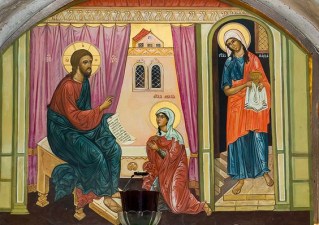
The Interior Life, and Martha and Mary

martha-and-mary-icon_edited-1smSome people, it is difficult to say “out-loud” like this, do not have an interior life.  Oh they are alive, in the natural sense of the word.  But in the supernatural sense of the word, in the sense that God wants us to have, they do not have much of an interior life, if at all.  An example in Scripture that suggests itself to me, is the Martha and Mary encounter with Jesus who had come for dinner, at their house.  We read,

Lk 10:38  As they continued their journey he entered a village where a woman whose name was Martha welcomed him.
39 She had a sister named Mary [who] sat beside the Lord at his feet listening to him speak.
40 Martha, burdened with much serving, came to him and said, “Lord, do you not care that my sister has left me by myself to do the serving? Tell her to help me.”
41 The Lord said to her in reply, “Martha, Martha, you are anxious and worried about many things.
42 There is need of only one thing. Mary has chosen the better part and it will not be taken from her.”

There in the presence of One who was at least a remarkable wise rabbi, if not yet known to them as the Holy God Incarnate, the Christ, Martha was distracted – “burdened” – with much serving.  Martha was living in and busy with the “outside” things – things to do, things to be responsible for, external matters that can define one’s life and one’s own person and one’s reason for being.  But the human person is much more than this!  The human person, each and every one of us, was created by God for much more – and Jesus came to reveal this “more” to us!

Mary, on the other hand, was seemingly oblivious to the busyness that so preoccupied her sister.  Mary was content – and apparently completely occupied – with just listening to this remarkable and fully engaging guest.  She sat there, at His feet – like a disciple would do – listening, just listening to His precious words.

Now this irresponsible behavior of Mary did not escape the notice of her sister Martha.  She, focused on the absence of her sister in the kitchen, was possibly unaware of the inappropriateness of what she was about to do.  She went to Jesus and said, “Lord, do you not care that my sister has left me by myself to do the serving? Tell her to help me.”  While Mary is quiet, listening and learning in His presence, Martha is presuming and ordering Him what He should do!  She presumes (and judges) that Jesus does not care about her, and that her sister does not care about her either, having left her alone to do the necessary work.

But what is necessary, in this moment with Jesus?  What is it that must be done?  Jesus communicates only tenderness toward Martha, but He says what must be said in the correction that authentic love requires: “Martha, Martha, you are anxious and worried about many things. There is need of only one thing. Mary has chosen the better part and it will not be taken from her.”

An interior life is the great good that makes us human.  What good is great success in the world outside of us, if the life inside of us is shriveling and drying up with thirst for that living water of the Holy Spirit – perishing in hunger for that Bread of Life that Jesus came to give us?  What good is accomplished if a man gains the whole world, but loses his soul – his life – his very self?

One thing is necessary – one thing.

The interior life is the unspeakably precious communion with God in the inner man, in the depths of the soul, in the quiet purity of holiness.  Life itself – supernatural life itself – is communion with Him, in a dwelling place unreachable and untouchable by any other.  There, at the foundations of the person, in the interior temple reserved for God and created and placed there by Him, there is the place of communion and the blessed bond of prayer.  The Catechism has this: “Christian prayer is a covenant relationship between God and man in Christ.” (#2564)

The interior life is the life of prayer.  It needs to be sought – and then, when found, cherished – protected – guarded – nurtured and tended.  It is neglected or assumed or presumed upon, at one’s own grave risk.  Jesus said it well, of course: “There is need of only one thing. Mary has chosen the better part and it will not be taken from her.”  It will not be taken because it is eternal, it is of God Himself and He is eternal.  But it can be lost.  How foolish, though, to lose the eternal in exchange for what is passing!  May God help us all to be wise, as we walk through this passing world.

And by the way: lest any readers leave this post, worried about or defensive of Martha – don’t worry about her.  She’s a saint now in heaven – she’s St. Martha!  And that is because she listened to Jesus, and watched Him, and her sister Mary, and she learned.  She grew in grace, and found the right and necessary “because of’s” for doing the service that she was naturally drawn to do, for others, in supernatural love.  This is what God wants for us: to be learners, and to learn, and to discover that precious inner life with Him.

*************************************

Does the Blog look a bit different?

If you haven’t noticed yet, please do notice that this website has changed quite a bit.  The Blog is as it was, except that now it is within a larger site, “Renew the Church.”  In the larger site are included several pages, with more on the way.  The menu, to date, is seen in the column on the right, the first menu being the Renew the Church pages, the second and lower menu being the old Blog posts as before.

There are several pages of videos, which you may want to investigate.  My hope is that this larger website will be more helpful to any and all who do want to grow in the interior life.  Most pages offer a “Comments” section, which I am always grateful to read.  I will OK the posting of all that I judge to be helpful to readers and to myself.  Blessings!  Let us pray for one another.  St. Martha and St. Mary, pray for us.

Thomas Richard

Posted by: Thomas Richard | February 11, 2017

Church, Will You Awaken Even Now?

I consider it divine intervention that Donald Trump, and not Hillary Clinton, was elected President last November. I prayed, like never before, for His intervention in that election, and against all “odds” (if you believe in “odds” in human affairs – which I do not), he won. Without the majority of voters voting for him, against opposition within his own party, and in spite of predictions by all the pundits, experts and many TV talking heads, Trump won. I can only believe God could do this.

And I think – believe – that God did this for a reason: to give the Church one more chance, one more opportunity to wake up and be Church! The forces of darkness in America were doing very well with either party in power! The evil one had been bending the culture of America toward the dark side for sometime now, and “successfully.” But God intervened. God held back the slide toward Sodom and Gomorrah, the drunken abandonment in America of reason and human dignity in preference for drugs, lust and lives of fantasy. Although His Church continued to busy herself with lesser things, God stepped in and intervened where she, by neglect, was not standing strong.

My question is, will the Church awaken even now? Though the bullet has been dodged and the train brought to stop inches before the cliff, I do not see her stirring even yet. The cancer has been held in remission, the execution was stayed, the evil plot foiled at the last minute – but I do not see the Church arising yet. Yes we can take a big deep breath that America is not yet irrevocably transformed into the child of the Culture of Death, but the danger is not eliminated. It is one battle surprisingly won, in a long war that is not over. And the evil one by no means is going to surrender!

As this long war has continued to rage, darkness has been advancing in our homes and schools, colleges and businesses, government offices and courthouses.  In the streets and cities and towns across America moral darkness has been unashamedly advancing. And through all this the Church mostly has been quiet, content with compromise, passive to the point of complicity. She has not taught her own, her little ones, the holy truth of real, eternal, victorious life. She has not led them to see and to know the life – here and now – of Christ the Lord. Entrusted with the Bread of Heaven, the Blessed Sacrament, she has not taught her own how to receive such a holy Gift, that they might be made strong, maturing in the power of the Sacrament. She has not led them to the personal encounter with Christ the Lord!  Entrusted with the riches and knowledge of the Kingdom, she has let her children feed themselves junk food, fast and easy food, food of this passing and confused world.

Church, when will you awaken? When will you recognize the enemy attacking your people at every turn, in their homes, in their schools, in their hearts and minds? They need the solid food of Truth! They need the potent power of Grace! They need communion with our Lord in Prayer! They need to hear evil called evil, and sin called sin, and lies called lies, and deceivers exposed as the mortal threats that they are! Enough, please, of frills and lace, of pomp and platitudes, of sweet lullabies while the enemy is gathering at the gates! They are dead-serious, and we are dozing in complacency.

Those who call themselves moral liberals or progressives, promoting their “new way,” are seething with rage in their unexpected defeat in the elections. They have money, they have many supporters, they have the long view. They are sincere, and committed! They lack something essential, something that the Church has, if she will awaken to it, and summon the courage to proclaim it and to live it. But if she will not awaken, here in America they will win.

Posted by: Thomas Richard | January 4, 2017

The Great Blessings in the Catholic Faith

The Catholic Church has been entrusted with the fullness of divine revelation, revealed perfectly in the divine Person of the Word become man, Jesus Christ. As the apostle John wrote:

1Jn 1:1  That which was from the beginning, which we have heard, which we have seen with our eyes, which we have looked upon and touched with our hands, concerning the word of life—
1Jn 1:2  the life was made manifest, and we saw it, and testify to it, and proclaim to you the eternal life which was with the Father and was made manifest to us—
1Jn 1:3  that which we have seen and heard we proclaim also to you, so that you may have fellowship with us; and our fellowship is with the Father and with his Son Jesus Christ.

Who is this “we” who were there with Him, to see and hear and touch Him? Those who were called into supernatural fellowship (Greek κοινωνία – koinōnia) with Him and with one another. This supernatural fellowship is made possible because of the Gift who is God Himself, given “within” human persons, the indwelling Presence of the Holy Spirit. This divine fellowship was the beginnings of His one, holy, catholic and apostolic Church (ἐκκλησία – ekklēsia, the “out-called”) – the men and women called out of the world and into Christ to share in His holy and eternal life! This sharing is possible only in, and by virtue of, the divine Holy Spirit, sent and given by the Father and the Son.

This same Holy Catholic Church today calls all men and women, in the name of Christ, out of the futility of this world and into the life of the Son, Jesus the Lord. This Church, His Church, can enable human persons to find, to receive, to embrace and to hold fast to their divine vocation to return to God, to live in Him in the fullness of life forever. This embrace of Christ is found and experienced in His way, a way of four facets, or dimensions:

1) The Truth. Jesus the Word of God is Truth. He entrusted to His Church of Apostles the fullness of revealed Truth, insured in them by the abiding Holy Spirit sent to be with them (and their successors) until the end of time. Because of this certainty, they and their successors could do what He sent them to do, with doctrinal certainty. His Church was entrusted with His Truth, thus they could teach, thus they could make disciples:
“make disciples of all nations, baptizing them in the name of the Father and of the Son and of the Holy Spirit, teaching them to observe all that I have commanded you; and lo, I am with you always, to the close of the age.” (Mt 28:19-20)

2) The means of divine grace: the Sacraments. Knowing the Truth is not enough to live in the Truth! Men and women need the power of God in them, to live His truth and thus to be His faithful witnesses for others in the world. Thus God empowered His Church with the seven-fold storehouse of His sacraments each with its particular sacramental graces: Baptism, Confirmation, Holy Eucharist, Confession, Anointing of the Sick, Matrimony and Holy Orders.

3) The true path of living His life: Christian Moral Truth. Knowing the Truth of God, and receiving the empowering grace to live His will, is still not enough to enlighten the actual path that human persons walk “in real life,” to know and to choose the way of righteousness in real-life situations today. Catholic moral principles give this light to men and women of today, married and single, living in a world far different from that in the days of Jesus, but guided by His Spirit, as He promised, light for “things that are to come”:

Jn 16:13  When the Spirit of truth comes, he will guide you into all the truth; for he will not speak on his own authority, but whatever he hears he will speak, and he will declare to you the things that are to come.

4) Finally, there is that “dimension” or ”facet” of life in Christ that must be included and considered: it is Prayer. We are called into the life of prayer, to grow in prayer, to grow in communion with Him, in His life. Every Christian has, by virtue of the abiding Holy Spirit, an “interior life” that is begotten by the Spirit, vivified by the Spirit, nurtured by the Spirit, and is satisfied and fulfilled only in intimate personal communion with God in the Spirit, and with brothers and sisters in that same Spirit. This “interior life” is the life of communio – of fellowship – of koinonia enjoyed by the Apostle John in the early Church:

1Jn 1:3  that which we have seen and heard we proclaim also to you, so that you may have fellowship with us; and our fellowship is with the Father and with his Son Jesus Christ.

This treasure – in its four-fold completeness – the Church was given, and her charge is to preserve and protect it in its fullness, and to offer it to all men in darkness that they may become free, finally, in Him.

These four aspects of Catholic Faith are much more fully developed in our current Catechism of the Catholic Church, available for exploration on-line. As Jesus said, “Come and see.”

Posted by: Thomas Richard | December 20, 2016

The Tree of the Knowledge of Good and Evil

Adam and Eve knew they were wrong to disobey God, but the temptation to eat the fruit was very strong. The evil one, the liar satan, told them what they wanted to hear and needed to hear, to quieten their conscience enough to will and to do the act of disobedience.  The temptation was to be like God! He told them, “No, you will not die; you will be like God, knowing good and evil.”

The forbidden tree of the knowledge of good and evil is a symbol of mortal spiritual danger both at the origins of human experience, and in our current realities in the world today. Knowing good and evil was no arbitrary test for Adam and Eve. No, it would not have just as well been any other test of obedience, such as “Never go into that one little house on the other side of the Garden,” or, “Never eat of that bush with the little red berries.” This test was specific: Never eat of the tree of the knowledge of good and evil.

What could be wrong with having such knowledge? Today it might seem to us that we need to have knowledge about what is good and what is evil! Is not a major problem we have today, in a modern “post-Christian” world, that we have no clear understanding of right and wrong, of good and evil? Isn’t a loss of Judea-Christian moral principles – replaced by amoral “political correctness” – a grave threat to our culture and society and nation? The Ten Commandments are hardly even suggestions anymore: indeed, they may as well have been written in pencil with eraser attached – forget the stone tablets – so flexible and adaptable they have become.

But no, this one forbidden tree in the midst of the Garden was of great and mythic significance. It carried within itself a test, a temptation, for human persons in every age and generation from the first to the last. The Catechism helps us to understand the importance of this test – and the dangers it presented and presents:

God created man in his image and established him in his friendship. A spiritual creature, man can live this friendship only in free submission to God. The prohibition against eating “of the tree of the knowledge of good and evil” spells this out: “for in the day that you eat of it, you shall die.” The “tree of the knowledge of good and evil” (Gen 2:17) symbolically evokes the insurmountable limits that man, being a creature, must freely recognize and respect with trust. Man is dependent on his Creator, and subject to the laws of creation and to the moral norms that govern the use of freedom. (Catechism of the Catholic Church #396)

This test, in other words, reaches to man’s very center of self-understanding: am I a mere creature under subjection to a Creator? I am drawn toward God; I am called into personal communion with God! I am made in His image and likeness! Does this mean I am a God too – that I should be my own God, a God unto myself? The evil one knew how to tempt Eve: “No, you will not die; you will be like God, knowing good and evil.”

The evil one covered and obscured the truth at stake in the decision set before mankind. ”Knowing good and evil” is much more than knowing about good and evil – it is much more than knowing merely how to discern good from evil.  The Catechism described well the root of this tree: “The tree of the knowledge of good and evil symbolically evokes the insurmountable limits that man, being a creature, must freely recognize and respect with trust. Man is dependent on his Creator, and subject to the laws of creation and to the moral norms that govern the use of freedom.” The temptation was and is this fundamental. Man is man, not God.

The temptation can be more easily understood if we consider carefully this tree and its fruit. The “knowledge” offered was to know good and to know evil as only God can, in His complete union with goodness, and His complete otherness and separateness from evil.  This meaning of the temptation can be seen in comparing other uses in Holy Scripture of the verb “to know” when used to describe the intimate, personal, interior union – meant in verses such as:

– Now Adam knew Eve his wife, and she conceived… (Gen 4:1, RSV)
– [Then Mary said,] How shall this be, since I know not a man? (Lk 1:34, KJV)
– I am the good shepherd; I know my own and my own know me, as the Father knows me and I know the Father; and I lay down my life for the sheep. (Jn 10:14-15, RSV)
– He who does not love does not know God; for God is love. (1Jn 4:8, RSV)

And so on.  To know good – in the sense intended in the forbidden fruit – would be to be God, who alone is one with goodness itself, who alone is in perfect union with goodness. To “know” in this sense is to possess the reality in one’s own nature, intrinsically and essentially. It is not merely to “know about” as all men are called to do, and to grow in such understanding as creatures of the all-good God ought to do. Jesus in a sense made this distinction when He corrected a man judging goodness carelessly:

And as he was setting out on his journey, a man ran up and knelt before him, and asked him, “Good Teacher, what must I do to inherit eternal life?” And Jesus said to him, “Why do you call me good? No one is good but God alone. (Mk 10:17-18)

Thus the temptation, to eat of this tree, is to be one’s own God – a God to oneself, free to define good and evil at will.  This temptation is as powerful and deadly today as it was in the Garden of Eden! This is the horror of our times: men want to define good and evil, right and wrong on their own terms, as they choose. And their choices always go from bad to worse, as they grow in arrogance and in distance from truth, and from the one true God.

We see the path of descent toward evil today, in our post-Christian society. Now men define evil as good, and good as evil!  Now men make it legal to kill the innocent unborn, and call it a “right”. Now men define their own genders as they please, and marry whatever they please, and un-marry whenever they please. Now they rob the innocent of all modesty, invading bathrooms and shower rooms and changing rooms as they please. Now men are stripped of masculinity and women of femininity, and they call it “equality.” Now all are stripped of human dignity, and they call it “liberation.” Now the children are robbed of responsible fathers, and of nurturing mothers, and they call it freedom from stereotypes. The children grow up without parents, and we discover a nation with no grownups.

The fruit of sin is death, America. Men who define good and evil for themselves, are following fools. God, who is good, is patient! But He will endure the foolishness of man, only so long.

Posted by: Thomas Richard | November 22, 2016

America: Is This One Last Chance?

President-elect Trump continues to build and staff his Cabinet, but the stunned shock of defeat postponed only briefly a seething rage among the humiliated “progressive” Democrats. They are now regaining a counter-offensive with bold if shallow threats and prideful promises. Meanwhile, I stand amazed at the miracle that – contrary to almost universal expectation and most of the polls and expert predictions – Mrs. Clinton and the Democrats did not win the election.

Yes I believe it was a miracle! I believe God intervened because of the prayers of His faithful ones. When I reflect on the damage that would have been inflicted on the nation by the Clinton machine, the corruption that would have even deeper and established even more firmly in our economy, our systems of justice, of education, of health, of immigration – indeed our democratic republic itself, I see how close we came to the precipice. And the damage would not have been merely secular, and so to speak external. No, the threat was to the very soul of the nation – the meaning of America – the very beautiful and Spirit-led heart of the founding principles and defining documents of the Republic. “One nation under God” was a principle one president away from being erased completely from the conscience of the nation, and God Himself saved us from falling. He held us back from the precipice; He kept us from the fall.

It used to be very different, in the America I grew up in. America was great because America was good, with a simple and beautiful goodness that we received from the hand and the heart of God. Ours was a culture of respect for the moral good, and the truth of divine revelation. We became a strong nation because the fear of God was real among us, and within us. We were not all saints, certainly, but God was acknowledged among the simple and the educated, among the rich and the poor – among the lawful and the criminals as well. Justice was believed in, and honored. Truth was important; hard work was rewarded and crime was punished. It was common for Sunday to be the day for worship, and for prayer, and for family. Priests and ministers were respected, as was marriage, as was one’s name and one’s word and promises. Along the way, America, we have lost a great deal. Where was the Church, as it was all slowly and gradually changing?

Do you know how close we came to losing this nation – to putting this nation of laws, with a Constitution to protect us and our human rights, into the hands of lawless Judges who feel free to make up laws and rights as they see fit? Do you know how close we still are to falling so far from “One nation under God” to a fragmented, shattered confederation of hostile tribes and identity groups under an all-powerful federal rule by whim and imperial fiat? The Lord has been very patient with us, His Church, as the darkness of the world around us continued to grow only darker.

I believe this, however, concerning the Church: He is giving His Church one more chance. He is God and I am not, and I don’t know that I personally would have given us another chance, so prodigal have we been with our blessings. But He is God and He has given us this one more chance to be who we are, and to be what we are sent to be: Light! We are sent to be His holy light in this dark world.

Where has the Church been, through the decades when this nation was in such grave moral decline? The nation morphed from a culture of life to a culture of death – from a predominantly Judeo-Christian nation to a predominantly materialistic and godless one. The light of revealed truth – even the light of the natural moral law – has been receding, dimming, fading into the horizon while an amoral darkness has begun to envelop the country. Barbarism, cruelty, animal-like inhumanity has crept in. And where has the Church been, as this enemy of souls was infiltrating every facet and corner of America? What has the Church been doing, instead of her holy mission? Whom has she been serving, when she was not serving her Lord and God? What have our parishes and pulpits been occupied with, when they were not occupied with the upbuilding of her people in holiness, and nurturing them toward the fulness and the maturity of Christ?

The more pressing question is, what will we do now? Will we seek holiness, as is our vocation? Will we be light, as is our mission? Will we be witnesses, as we are sent to be, of His life-giving Spirit? Will we see the one door open before us – the door that may be the last chance we will have – to seek His will and do it? Will we pray with all our hearts to do His will no matter the cost? Will we offer Him all that He has entrusted to us, in hope that He may use it, and us, for the glory of His work in this His creation? Thy Kingdom come, Father! Thy will be done on earth, as it is in heaven! Hallowed be Thy name.

Thomas Richard, 11/21/2016

« Newer Posts - Older Posts »

Categories